Saturday, October 13, 2007

Red, White & Blue Meatloaf

This weekend we are celebrating our friend Eric becoming an American citizen. And what better way to fete Eric, the Frenchman, and his embrace of the good ol' U.S. of A. as his permanent homeland, than with a meatloaf?

Actually, there will be much more to this celebration. But I wanted to get right to the meatloaf because it happens to coincide with our friend Kevin's call over on the Seriously Good blog for a national meatloaf recognition.

I am not afraid to admit that I love meatloaf but rarely think to make it myself. My wife and I are always hoping that friends, who often are too shy to invite professional cooks for dinner, will have us over for their version of meatloaf.

The very name has a clumsiness about it--a loaf of meat, as if we could confer respectability on hamburger by making it look like a brick of Wonder Bread. In fact, meat loaf is a triumph of flavor over design. The notion of passing unloved cuts of meat through an extruder to create something divine is nothing to be ashamed of. This is pure human ingenuity at work, applying mechanical wherewithal to otherwise unappetizing bits of animal flesh.

Meat loaf is singularly American, a hamburger putting on airs, you might say, but too humble to call itself a pate. Because it lacks sophistication, there is a certain shame factor in our love for meatloaf; our embrace of it as "comfort food" has an infantile quality. We prepare it at home for family, rarely for guests. And yet what a thrill to find it on an actual menu, usually at some unassuming roadside diner where it is served with mashed potatoes, gravy and steamed carrots. We love it because we are famished and, like any iconic food, it reminds us who we are.

I do not have a personal meatloaf recipe. In my house growing up, we ate something called "Porcupines"--large meat balls made with uncooked rice and probably one of the hundreds of different Lawry's spice mixes that filled our kitchen cabinets, then baked in a casserole with a tomato sauce. Sorry, no idea why they were called "Porcupines," but they served the same workmanlike purpose as the neighbor's meat loaf.

On those occasions when meatloaf is called for, I've adapted a Tyler Florence recipe he calls "Dad's Meatloaf." Again, no idea how dad figures into this. This is definitely an update of the classic, combining ground beef with ground pork for additional flavor. Hearty white bread soaked in milk is worked into the meat, recalling a rustic Italian meat ball. What sets this loaf apart, though, is a piquant relish of red bell peppers, tomatoes and ketchup that seasons the interior of the loaf, is coated onto the loaf before it goes into the oven (along with strips of your favorite bacon, by the way) and then is served on the side as a sauce.

I would urge you to consider making your favorite mashed potatoes with this meat loaf and a vegetable with some pizazz--perhaps some roasted Brussels sprouts?

To serve 8 - 10:

For the tomato relish:

extra-virgin olive oil
1 onion, diced small
2 garlic cloves, minced
2 bay leaves
2 red bell peppers, cored then diced small
1 14-ounce can diced tomatoes
1/4 cup finely chopped parsley
1 12-ounce bottle ketchup
1 tablespoon Worcestershire sauce
salt and freshly ground black pepper to taste

Coat the bottom of a skillet or heavy pot with olive oil, then over moderate heat saute onion, garlic and bay leave until onion is tender. Add red bell pepper and continue cooking until peppers are soft. Add tomatoes, then stir in parsley, ketchup and Worcestershire. Season with salt and pepper. Continue cooking several minutes until the flavors are melded. Remove from heat and set aside to cool.

For the meatloaf:

3 thick slices rustic white bread, crusts removed, torn into pieces
1/4 cup whole milk
1 1/2 pounds ground beef
1 pound ground pork
2 eggs
leaves from two thyme sprigs
salt and freshly ground black pepper
6 slices hickory-smoked bacon

Preheat oven to 350 degrees.

Place the torn bread and milk in a bowl and mix gently to moisten bread. Set aside.

In a large mixing bowl, combine the ground beef and pork with 1 1/2 cups of the cooled tomato relish, the eggs and thyme. Season with salt and pepper. Squeeze excess milk from the bread and add the bread to the meat mixture. To test for seasoning, fry a bit of the mixture and taste.

Lightly grease a baking sheet or cover with parchment paper. Dividing the meat mixture in two, form two loaves on the baking sheet. The mix will be a bit moist, but should hold together by itself in a loaf shape. Lay three slices of bacon lengthwise over each loaf. Spread tomato relish over the bacon.

Place in the oven a bake about 1 hour, or until a thermometer inserted into the middle of a loaf reads 160 degrees.

Friday, October 12, 2007

Cucumbers Are Slippery

One of the ideas I like to introduce to the kids in my "food appreciation" classes is that good food doesn't always have to be cooked. I also like to show them how people used preserve food so they would have good things to eat all year 'round.


That leads me into the subject of cucumbers, because they're delicious raw as well as pickled. So this week we made a cucumber salad as well as starting two buckets of pickles.

This is one of those lesson I like on multiple levels. Not only does the food lend itself to teaching about freshness and preserving, we also get to practice some of our basic kitchen skills, such as peeling and slicing. And we can do some math along the way as well.


First we take two large cucumbers and I slice them crosswise into two pieces. That makes four, which I distribute among the class. The kids then take turns peeling the cucumber halves. This is not as easy as it sounds. Many of the children are still learning how to peel. They whack at the cucumbers or whittle away furiously. Several times I demonstrate how to hold the peeler correctly against the cucumber, and peel away the dark skin only in slow, methodical strokes.

When the peeling is finished, I slice the four cucumber pieces in half lengthwise. Now we have eight pieces. Again I distribute the pieces among the kids and they use spoons to scoop out the seeds. Some kids say they like the seeds. But I think the seeds are bitter and not worth eating. So we remove them. Now we have eight little cucumber boats.


For the final step, I bring out the mandolin. We used the mandolin the previous week to slice zucchini, so the kids know what it is and are excited to see it again. We take turns slicing the cucumber boats into thin crescent shapes, learning how to hold the vegetables properly so that certain parts of the fingers aren't sliced off in the process. When we're done, we have quite a pile of thinly sliced cucumber.

I put the cucumber slices in a cucumber bowl to make the simplest possible cucumber salad. Kids love sugar and salt. To dress the cucumber, we simply sprinkle on a little kosher salt, toss, then season it lightly with a splash of distilled vinegar.

Some of the kids think the salad would be good with extra-virgin olive oil or ground pepper. And of course you could use a flavored vinegar, dill weed, even cream for a Scandinavian-style cucumber salad. But we're just going to put our cucumbers away to marinate for a few minutes while we assemble our pickles.


Along with the slicing cucumbers I've brought several pounds of pickling cucumbers from Whole Foods. The pickling process is so simple, and I've mentioned it here a number of times. Cucumbers go into a heavy plastic bucket with salted water, mixed six tablespoons of pickling or unadulterated sea salt to one gallon of water. We then add generous amounts of dill weed and garlic cloves.


The kids have been asking ever since school started whether we would be making pickles again. So here we are. They get to plunk cucumbers into the bucket, then we have a short math quiz: If we have a two-quart measuring cup filled with water, how many gallons is that? And if we make half our recipe, how many tablespoons of salt do we need for one half a gallon?


(It isn't till grade four that the kids start to shout out the answer. The younger kids just stare at me.)


We add the water and the other ingredients to the cucumbers, place a ceramic plate over them, weigh the plate down with a plastic container full of water, then cover the whole thing with a kitchen towel to keep dirt out. The bucket will sit in a corner till next week, when the pickles should be ready to place in jars and refrigerate.


Now, to eat our cucumber salad. The kids are definitely more enthusiastic than they were with my zucchini carpaccio with goat cheese the week before. They take up their plastic forks with relish. And I would say most of the kids finish the salad, but there are still a fair number who just don't like these green vegetables.


Could it be time for a vegetable soup?

Thursday, October 11, 2007

Is it Fall Yet?

The very nasty heat wave that has been sitting over the District of Columbia, bringing August to October all over again, has finally lifted. At precisely 2:13 am it was no longer necessary to sleep outside the sheets. I know, because I was awakened by a sudden chill wafting through the open bedroom window and looked at the clock to note the time of this propitious moment.

We should have been feeling a bit of crispness in the air and temperatures in the 70s. Instead, we've been baking in 90-degree heat. It's difficult to be a motivated urban farmer in these conditions. The plants don't like it either. I'm convinced that my turnips and rutabagas have simply refused to germinate. I'm on my second plantings of arugula and mizuna--the first flush of seedlings just burned up. The lettuces have been looking like they want to bolt and go to seed.

The forecast now is for much cooler temperatures during the day and down into the 40s at night. It is a welcome relief to be experiencing autumn at last.

Wednesday, October 10, 2007

Heart-Healthy Muffins

Until I started making heart-healthy personal meals for clients two years ago, you could say I had zero interest in muffins. I soon developed an intense interest in these famous little baked goods for all the nutritious ingredients they can pack into a breakfast, lunch or snack.

Who doesn't like a muffin? That's the first good news. You don't have to twist anyone's arm to bite into a muffin. A muffin is an almost universal signal that good things are about to pass by your taste buds. But from there, a lot can go right or wrong with a muffin, depending on what's inside.

Most muffins constructed for the general public are made with lots of fat and sugars. Some years ago muffins became hugely popular. Then consumers started to learn how many calories--and especially fatty calories--were packed into those barn-sized muffins they were picking up at the coffee shop and wolfing down on the way to work. Those muffins weren't healthy at all. In fact, they were a disaster.

You can recognize almost immediately a muffin you want to stay away from. Just scan the ingredients. Typically, there will be cups of refined white flour, butter and refined sugar. To which I say, No, No and no. As I became more conscious of the ingredients I was using in my personal chef business, I learned about the glycemic index and the throttling of the pancreas, the insulin jolts that occur around refined flours and sugars. These are first-class tickets to weight gain, high blood pressure and diabetes. Avoid them.

The first thing I look for in a good muffin is fiber. Everyone should be trying to include more fiber in her diet. Fiber helps remove bad fats from the system and introduces bulk while cleaning out the digestive tract. Whole grains, along with many fruits and vegetables, are primary sources of dietary fiber. My first objective is to work more whole grains into my muffins.

Next, a recipe for healthy muffins will use all kinds of stratagems and different ingredients to replace traditional lipids and sweeteners. In fact, the recipe list for a healthy muffin can look too long, almost daunting. Don't be deterred. Yogurt, canola oil, apple sauce, apple juice, orange juice--one or more of these often will appear in a recipe for a good muffin. Expect to use multiple ingredients to develop an appealing level of texture and sweetness while packing in the nutrients. But note: this style of muffin will not attain the sweetness or fatty mouthfeel of the typical commercial product.

Finally, I try to work as many other healthful ingredients into my muffins as I can. My eyes light up around seeds and nuts, berries and fruits and vegetables high in nutritients such as carrots, sweet potatoes, certain squash, and even beans. I know a great recipe for a savory black bean muffin that makes a dynamite sidekick for a bowl of soup.

Along the way, I've learned to adapt some recipes, replacing, say, half the refined white flour with whole wheat flour. I've recently discovered something called "white whole wheat flour" that is--as the name implies--whiter than the traditional whole wheat. I'm not a baker by training, and I have no idea how they make whole wheat flour white. But it works, resulting in less of a granola-like muffin. I've also recently discovered advantages to replacing some of the whole wheat flour in muffin recipes with whole wheat pastry flour. This gives the muffin a pleasingly pillowy quality compared to the typical crumbly muffin.

This week my daughter helped me make several dozen muffins that we put away in the freezer and will use in client breakfasts and lunches in the coming months--setting a few aside for us as well, naturally.

I use a traditional, 12-muffin tin, greasing it with a canola oil spray. Once the muffins are baked, I let the tin cool for a few minutes. As soon as the muffins can be handled, I use a paring knife to remove them from the tin (I don't use paper or foil muffin cups any more), then set the muffins on a wire rack to cool.

Here are two of my favorites: oat bran with blueberries and a sweet potato muffin with grated carrots and sunflower and pumpkin seeds.

Oat Bran Muffins with Blueberries: Oats are among the best foods you can eat, period. Blueberries are packed with anti-oxidants and other nutrients.

To make 12 muffins:

1 1/2 cups oat bran
1 cup unbleached all-purpose flour
1/2 cup whole wheat pastry flour
2 teaspoons baking soda
2 teaspoons baking powder
1 teaspoon ground cinnamon
1/2 teaspoon salt
1 cup plus 2 tablespoons applesauce
2 eggs lightly beaten, or 1/2 cup egg substitute
1/2 cup orange juice
2 tablespoons canola oil
1 teaspoon vanilla extract
1 1/4 cups fresh or frozen blueberries
1/2 cup coarsely chopped walnut pieces
1/4 cup rolled oats

Preheat oven to 400 degrees Fahrenheit

In a large bowl, mix oat bran, flour, pastry flour, baking soda, baking powder, cinnamon and slat. In a separate bowl, mix applesauce, eggs, orange juice, canola oil and vanilla extract. Add wet ingredients to dry ingredients and stir to blend. Fold in blueberries and walnuts.

Spoon muffin batter into a greased muffin tin. Sprinkle rolled oats of tops of muffins and press oats gently into mix. Place in oven and bake about 18 minutes, or until a tooth pick inserted into a muffin comes out clean.

Sweet Potato Muffins: Sweet potatoes are a miracle food. They are full of anti-oxidants--carotenoids and Vitamin C--help regulate blood sugar, reduce inflammation and brings tons of Vitamin A, manganese and other essential minerals to the table as well as dietary fiber. As an added bonus, these muffins also contain carrots, also high in carotenoids, vitamins and fiber. And they are topped with sunflower and pumpkin seeds, both high in essential amino acids. In my book, this as a perfect muffin.

For 12 muffins:

1 cup unbleached all-purpose flour
1 cup whole wheat pastry flour
2 teaspoons baking powder
1/2 teaspoon baking soda
2 teaspoons ground cinnamon
1 teaspoon ground ginger
1 teaspoon salt
1/2 cup canola oil
2/3 cup brown sugar
2 large eggs, or 1/2 cup egg substitute
2/3 cup non-fat yogurt
2 teaspoons vanilla extract
1 1/2 cups shredded carrot
1 cooked and mashed sweet potato
sesame seeds
pumpkin seeds


Cook the sweet potato ahead in a 350 degree oven and set aside to cool


Preheat oven to 375 degrees

In a large bowl, mix together flour, pastry flour, baking powder, baking soda, cinnamon, ground ginger, salt. In a separate bowl, mix together oil, brown sugar, yogurt, vanilla. Stir in carrot and sweet potato. Pour wet ingredients into dry ingredients and mix until just blended.

Spoon the batter into a greased muffin tin. Sprinkle sesame seeds and pumpkin seeds over each muffin, then lightly press the seeds into the batter.

Place in oven and bake about 25 minutes, or until a a tooth pick inserted into a muffin comes out clean.

Tuesday, October 9, 2007

Columbus Day Outing to Whole Foods

Weekdays off come with a bit of a sting for parents because that of course means no school, which means activities must be found for the kids who are home for the day. This is where I as parent and erstwhile role model put on my cheerleader hat, trying to interest a certain 7-year-old in getting dressed out of her pajamas, turn off the television and join me in a walk to the grocery store.


"I don't want to go to Whole Foods!" she screams, throwing herself backwards against a sofa cushion and kicking her feet into the air. "I've been there two days in a row!"


I take that as a 'No' and switch into a higher gear, explaining that the reason for the grocery outing is to purchase ingredients for muffins that I am making for a client and that we can have so much fun when we get back making muffins together.


"I don't want to make muffins!" is her less-than-enthusiastic response.


I then switch into bribing mode, holding out the possibility that there may be some kind of delectable treat waiting for her at Whole Foods, yet to be discovered but only if we start walking there sometime within the next 15 minutes.


"No!"


As a final inducement, I encourage her to think how miserable she'll be sitting in front of the television all day in her pajamas. With a heart full of love and kindness, I growl, "Turn off the television!"


A few minutes later I find that she has had a change of heart. She is indeed getting dressed and ready to go. Now my wife is at the door urging us to take the canvas shopping bags she has purchased from Whole Foods. We are doing our part to save the world from plastic shopping bags, only I keep forgetting to take the more eco-friendly bags.


By way of cementing our resolve, and assisting my memory, my wife says, "There will be no more plastic bags allowed in this house. Don't even think about coming back with a plastic bag." She hands me the canvas bags and we are off.


Our local Whole Foods is about a 20-minute walk and I figure both daughter and I can use the exercise. Daughter is less convinced.

"Why can't we take the car?"


"Don't be silly," I say. "Look what a beautiful day it is! It's a great day for a walk."


"But my legs hurt."


"You're a young kid. You've got lots of energy."


"But my legs are really going to hurt."


"Do we need to take you to the doctor?"


"No."


In fact, it is a lovely walk, although I feel a bit silly carrying two bulging packages of used plastic shopping bags in one hand. They won't be recycled if you leave them at the curb. I'm taking them back to the Whole Foods to do whatever they do with used shopping bags.

Our shopping list is fairly short: honey, eggs, egg substitute, a sweet potato, some whole wheat pastry flour, frozen blueberries and something called lecithin granules. This to make several different kinds of heart-healthy muffins that I will put in client meals over the coming months. I have a feeling there could be some surprise waiting over the lecithin granules. I have no idea what they are or why they are called for in a recipe for "coffee cake muffins."


Sure enough, the lecithin granules turn into a bit of an adventure. The man at the customer service desk gives me a blank stare. After waiting several minutes for someone from "grocery team" to arrive and show me where they are--if they exist--I walk around the corner to see if the store concierge has a clue.


I like the concierge. Like a good hotel concierge, he seems to be always primed and ready for the next challenge. He can't wait to help you with your most outrageous request. When I tell him we are looking for lecithin granules, he screws his face into an expression that says, "Never heard of 'em, but if that's what you need, I'm sure we can find some around here someplace." I like that.


The concierge disappears into his den for a moment to check for lecithin granules on his computer, then reappears saying they are most likely to be in the "Supplements Section."


Here I'd been scouring the baking aisle, looking up and down and all around for the mystery ingredient, when it turns out lecithin is some sort of vegetable concentrate providing "97% soy phosphatides," whatever those are, along with "phosphatidyl choline" and "phosphatidyl inositol." I have no idea what any of this means, or why I would need them in a muffin. But I feel I am somehow broadening my healthy muffin horizons. I take a $10 bottle of lecithin granules.


Our shopping complete, I wonder what treat I can possibly offer daughter, who has been pushing our shopping cart around the store the entire time. The stuffed animal strapped into the kid's seat is supposed to be a squirrel, except in a strange almost grotesque twist only a 7-year-old can appreciate it has the face of a child. Daughter calls her, aptly, "Squirrely."


Daughter is drawn to the steam table and the selection of soups. I hesitate. In all the years I've been coming to Whole Foods, I've never eaten the prepared foods. These days, Whole Foods turns into a veritable restaurant around lunch-time. I am convinced that every Ethiopian cab driver in the District of Columbia for some reason chooses to eat lunch at Whole Foods. At noon, the parking lot at Whole Foods looks more like the taxi stand at National Airport.


Daughter decides on a small cup of chicken noodle soup. At first I am loathe to eat anything. But I relent, making a box of lentils, couscous, chickpeas, steamed tofu.

It all looks suddenly very appetizing. We actually find an empty booth, but that is because the table is falling off its legs and wobbles dangerously whenever you touch it. Nevertheless, daughter happily thrusts a spoon into her soup. My food, though colorful and authentic looking, is rather bland. I'm not sure whether this is for the benefit of the general "I-don't-do-ethnic" public out there, or because the chef is missing some taste buds. For my taste, some seasoning would be nice.


But we have a swell lunch together, daughter and I, just the two of us. It's amazing how quickly kids can recover from a tantrum in front of the television. Persistence is a virtue, and sometimes makes parenthood grand.

Monday, October 8, 2007

Composed Salad from the Garden

Quick! Inlaws are in town and coming to lunch. What do you do?


Well, I wanted to show off the garden, of course, so a salad leaped to mind. The advantage to that is, hardly any cooking at all. And since I was in the middle of making client meals, less additional cooking turns out to be a big plus indeed.


We planted a rather large bed of potatoes this year. That was the first place I checked. A potato bed is like having a secret bank account. It will sit there patiently while you eat other things. Then when the occasion arrives, you simply start poking around with your forked spade to see what turns up. In this case, a few turns of the spade revealed some long, narrow purple potatoes as well as a variety of reds. I swear, I really have no idea what's hiding in that soil. The potato sets all came from our farmer friend Mike and I never made a note of what variety they were. But it sure is nice to have them when you want them.

Most of our tomato plants are fading, but there are still some big, juicy fruits on the vine. I would definitely cut some of those into wedges for the salad. We also had a few pasture-raised eggs in the fridge. Hard boil those. But the salad needed something more. We made a little trip to the new farmers market down the street. It's a lovely thing to have a farmers market just a few blocks away and there I saw the biggest, most outstanding heads of broccoli I've even encoutered. Bigger than life, really. I had no idea they could grow to that size. Also some extremely lovely and fresh green beans from the same farm. They were just the thing...


A big pot of salted water will satisfy most of the cooking needs for a composed salad. Green beans, broccoli, potatoes--all were cooked just to doneness, then chilled in a bowl of cold water. We have several varities of lettuce in their prime now. I planted them for fall, but it's been so hot here I'm just hoping they don't bolt. We're experiencing an August in October.

My wife, the food artist, arranged the vegetables on a big, green, decorative platter, then filled a squirt bottle with a light mustard vinaigrette. We would present the platter at the table and let the guests serve themselves.

For the occasion, brother-in-law Tom, the oenophile, brought a lovely bottle of Washington State late-harvest Reisling. Tom was smitten with the freshness of the tomatoes. They don't get any better. Midway through lunch, he had to run back to the kitchen and slice some more.

Catching up with family should always be like this, lingering over a fresh garden salad and sipping a delicious wine...

Sunday, October 7, 2007

Weekend Update


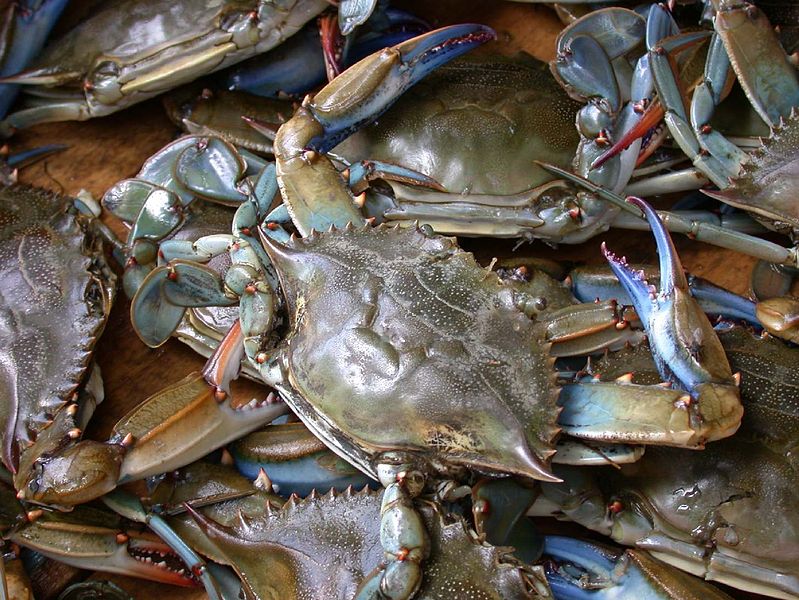
Years ago, in what must have been another lifetime, I wrote in The Washington Post that the famous blue crabs of the Chesapeake Bay were heading for trouble. For such effrontery, I was very nearly subjected to a lynch mob of angry watermen.

Flash forward from the late 1980s and the National Oceanic and Atmospheric Administration (NOAA) is reporting one of the lowest crab populations in the bay on record. According to dredging samples taken just prior to the 2007 season, new crabs were at their second-lowest number since the survey began in 1989. According to NOAA, these findings continue a trend that has plagued the crabs for the last decade.

In fact, the 2006 blue crab harvest of 49 million pounds for the entire Chesapeake was one of the lowest recorded since 1945. The 2007 harvest was predicted to be even less.

It's a sad state of affairs for the once super-abundant Chesapeake. The blue crab--or "beautiful swimmer"--has for centures stood as a living symbol of fecundity for the world's largest tidal estuary. But like the oyster--now nearly extinct in these waters--the blue crab almost unthinkably finds itself in the throes of a long, inextricable decline.

Mankind continues to turn virgin shoreline into housing developments and marinas. Surrounding farms and millions of homes and lawns from the huge Chesapeake watershed continue to pour pollutants into the bay. There is always talk about taking action, but little seems to improve. Many areas of the bay are now subject to huge "dead zones" where pollution-loving algae suck all the oxygen out of the water.

The town of Crisfield, MD, used to be the world's foremost supplier of crab meat and soft-shell crabs. Now, the crab on your plate is just as likely to come from a mangrove swamp in Southeast Asia.

Still, NOAA declares that the blue crab is not overfished. Management goals call for a harvest of up to 53 percent of the entire crab population. Does that sound reasonable to you?

*****

The Mediterranean population of bluefin tuna, beloved by sushi chefs, may be on the verge of a complete collapse. Some estimates put the bluefin population there at a mere 6 percent of its original abundance. What's more, the tuna that are being caught and sent to market are getting smaller and smaller.

Part of the blame goes to the increasingly ingenious technology being used to catch the tuna, including illegal spotter planes that routinely scout Mediterranean waters and radio fishing fleets where to cast their nets. But European governments have also set quotas sometimes double the amount scientists have recommended.

The bad news for tuna is, the fewer of them available to catch, the more the price on their heads rises. The International Commission for the Conservation of Atlantic Tuna (ICCAT) this year halted bluefin tuna fishing and threatened court action against several member countries--Greece, Malta, Portugal, Spain, Italy, France and Cyprus--unless they could prove they were not overfishing.

"When you are down at very low biomass levels all it takes is one or two bad years to start the downward spiral from which it would be difficult to return," said Gerald Scott, the American chairman of ICCAT's scientific committee. "We haven't necessarily seen a rapid and drastic decline yet. The point is once you have, it is probably too late."

"It's over," lamented one Spanish fisheries consultant. "That's my gut feeling from both a stock point of view and a business point of view."

*****

As if deciding which fish to eat weren't confusing enough, the National Healthy Mothers, Healthy Babies Coalition this week came out with a recommendation that pregnant women should consume a minimum of 12 ounces of fatty fish each week in order to accumulate enough omega-3 fatty acids. The recommendation is a puzzler, since it comes from a long-standing and highly regarded organization and directly conflicts with federal government recommendations that pregnant women or women planning to become pregnant consume a maximum of 12 ounces of fatty fish per week because of the risk of mercury poisoning.

Could there be any meaning in the fact that the study behind the Healthy Mothers, Healthy Babies group was funded by a $60,000 grant from the National Fisheries Institute, a seafood industry group?

"I really think that's the wrong recommendation to be making," Frank Greer, chairman of the nutrition committee of the American Academy of Pediatrics, told National Public Radio. "We really should not be implying that women should be eating more than 12 ounces of seafood."

Christina Pearson, spokeswoman for the U.S. Department of Health and Human Services, told NPR, “We are members of the coalition, but we were not informed of this announcement in advance, and we do not support it."

Caveat emptor...

*****

Fun fact of the week: there's less sugar in a Krispy Kreme donut than in a bowl of Post Raisin Bran cereal. In fact, it might be a good idea to check the ingredients in the stuff you're feeding your kids in the morning. Breakfast ain't what it used to be, according to this piece in Salon.

*****

Finally, it appears that the gold rush fever around our old pal, ethanol, may have produced something of a glut. It seems that the infrastructure needed to bring ethanol to market isn't quite ready yet, meaning all kinds of new ethanol manufacturing facilities have been thrown into high gear with nowhere for all the new fuel to go.

As you'll recall, all the politicos in Washington have jumped on the ethanol bandwagon, mandating that we turn more and more of our corn into fuel to reduce dependence on foreign oil. The result has been a doubling in the price of corn, record planting of corn, a tortilla crisis in Mexico and higher food prices around the globe.

But ethanol is highly corrosive and cannot be transported in traditional pipelines. It has to be shipped by trucks or rail, and there simply are not enough of those to handle the sudden surge in capacity.

Partly because of the ethanol craze--but also because of the food demands of a growing middle class in countries such as India and China, and maybe because of bad weather caused by global warming--commodity prices are up around the globe. The price of corn is up 40 percent in the last year, soybeans 75 percent and wheat 70 percent. A box of Wheaties now costs more per ounce than London broil.

That's all bad news for the poorest of the world's poor. But as if paying more just to stay alive weren't hard enough, the conversion of food to fuel also means governments are providing less food aid to the hungry.

The budget working its way through Congress shows no signs of increased spending on food aid. Data from the U.S. Department of Agriculture show that the cost of food for the federal government’s main food aid program, Food for Peace, rose 35 percent over the past two years. Meanwhile, the number of people being fed by American food aid has declined from 105 million in 2002 to 70 million last year.

An estimated 850 million of the planet's people are hungry. “We fear the steady rise of food prices will hit those on the front lines of hunger the hardest,” said Josette Sheeran, executive director of the United Nations World Food Program.

Bicycle, anyone?