Tuesday, March 31, 2009

Breakfast

Swiss cheese omelet with Canadian bacon and onion tops.

Preparation: 10 minutes

Shopping: none

A high quality Emmentaler cheese brings a great deal of flavor and a bit of saltiness to this omelet. I also dice some Canadian bacon stored in the fridge. This time of year we are growing onion in seed trays for transplanting in April. As the slender leaves get very long and begin to topple over, I cut them back and scatter the trimmings over my eggs. They taste like chives, but even stronger.

For a high-protein breakfast, add a couple of slices of your favorite bacon. We like ours from Benton's, but when that runs out the slab bacon from Whole Foods makes a worthy substitute. Or perhaps you've found a bacon you like at the local farmer's market? I roast the bacon on a parchment-covered baking sheet in a 350-degree oven. Save the grease for frying and sauteing.

Monday, March 30, 2009

The Last Fish: Calamari Veracruz

I promise this will be the last time I talk about our favorite Veracruz sauce for a while. But we still had some left over (after at least one other catfish dinner and a breakfast) and so I tried it on a pound of squid.

Squid is not to everyone's taste unless it's been battered and fried and served as calamari fritti with a pint of beer. But I happen to like the pristine flavor and slightly chewy texture of squid au naturel. Squid also happens to be economical relative to most seafood and having just come off a sustainable seafood symposium I thought I'd try eating a little lower on the food chain. Squid are abundant and get a big, green "best choice" rating from the Monterey Bay Aquarium's "Seafood Watch" program as long as they're the "common squid" caught in the U.S. Atlantic.

I bought these squid at Whole Foods already cleaned. Otherwise, you need to reach into the squid cavity and pull out the guts as well as the cartilage that serves as the squid's backbone. There's also a very thin, purplish membrane covering the squid's body that needs to be removed. Then just give the squid a good rinse. Cut off and reserve the tentacles. If the squid hasn't already been cleaned when you bought it, you will need to find the squid's beak in the tentacles and remove that as well.

To cook, just bring the Veracruz sauce to a light boil in a skillet and add the squid. Toss the squid for a minute or two until it is just cooked through. Too much cooking will make it tough. Serve immediately, perhaps with a little chopped parsley for garnish.

We ate ours with some leftover curry-roasted cauliflower that seemed to work particularly well the olive-jalapeno-cinnamon-clove flavors of the Veracruz sauce. I'm beginning to think this sauce is worth making ahead and freezing, it works so well with a variety of seafood.

Sunday, March 29, 2009

Of Bears, Opossums, Asapargus and pH

What with the confrontation between dogs and bears and the opossums eating the chickens, it was a very busy week for farmer Lee Hauter.

An unholy row forced Lee out of bed one night. A bear he recognized from last fall apparently had risen from its long hibernation and approached the farm looking very skinny and hungry. Lee's two big Pyrenees dogs, fierce defenders of the property, rushed to inform the bear he was not welcome.

Fortunately, dogs and the bear were separated by a fence. After some fierce gnashing of teeth and viscious snarling, the bear departed back into the woods.

Then on Friday night Leigh awoke from a dream in which raccoons were eating his chickens. He shook it off and went back to sleep. But now he regrets not following his inner voice. That night with all the rain a section of the movable electric fence that surrounds one of his chicken broods collapsed. Opossums--not raccoons--took advantage and killed five of Leigh's chickens.

Wait. Opossums eat chickens?

"You can tell it was opossums," Leigh said, "because they suck the innards right out."

Good to know.

Besides these flirtations with the wild animal kingdom, Leigh did have some business to take care of--like the hoop houses that needed building, and bees that needed feeding, the 600 asparagus roots that needed planting, the 300 raspberry brambles that arrived and the 100 horseradish roots.

I was particularly interested to hear about the asparagus because my wife and I have our eyes on a patch of yard where we plan to put our own asparagus. Of course Leigh works on a much larger scale. About four years ago he planted 1,500 roots for Bull Run Farm's CSA subscribers. The 600 he ordered this year were meant to replace some plants that had been lost in the intervening years.

For the asparagus, Leigh pulls a bottom plow behind his tractor creating a trench about 10 inches deep. In the past he would toss horse manure into the trench and lay the asparagus roots on top. Asparagus can also be grown from seeds. But most growers prefer to buy the root stock. It takes about three years for the asparagus roots to become firmly established before you start harvesting the delicious stems.

Horse manure sounded familiar. That's precisely what my wife had proposed to do: dig a big hole and fill it with horse manure to rot while the asparagus was establishing itself. But Leigh says his grower now advises very firmly against horse manure or even compost until the asparagus is actually growing. Leigh says the issue is creating a soil that is too acid. Asparagus prefers a pH in the range of 7 to 7.2. So instead of tossing horse manure into the trench he added some bone meal.

"Bone meal is more expensive than lime," Leigh said. "But I'm going for the extra nutrition."

Leigh said that over the years he's become especially aware of his soil's pH. A soil's pH--a measure of less than seven indicating acidity, more than 7 indicating alkalinity--governs a plant's ability to take up nutrients through its roots. Some plants, such as blueberries and potatoes, like an acid soil. Other plants, such as cabbage and other brassicas, prefer a more alkaline soil. Most vegetables, in fact, prefer a soil that is slightly acid--somewhere in the range of 6.5 to 7.

"I test the soil around the farm all the time," Leigh said. "I'm a lot more concerned than I used to be."

What really focused Leigh on soil pH was a particular field on his farm that never seemed to perform up to par. No matter what he planted there, the yields were never good. "It always seemed to look parched," Leigh said. Finally he sent some of the soil off for analysis and learned that it was too acid. The lab gave him a specific recommendation for how much lime to add to balance the acid.

After that, Leigh stopped at the farm supply and purchased his own pH measuring tool. "I spent a couple hundred bucks on it," Leigh said. Apparently, that would be $200 well spent.

Saturday, March 28, 2009

Watch Slow Cook on Television

This must be the week when the news media wake up to spring and want to interview The Slow Cook in his garden.

We've been interviewed about chickens by WAMU radio, appeared on the Kojo Nnamdi show to talk about food gardening and yesterday we entertained a film crew from FOX News to talk about planting vegetables.

FOX is calling it "recession gardening" and it's supposed to appear today on America's News Channel sometime between 2 and 4 pm, then again at 4:30. That would be one of FOX's cable channels, and unfortunately we no longer take cable (or satellite, in our case). They said channel 32 or 37 here in the Washington area, but who knows if that's correct.

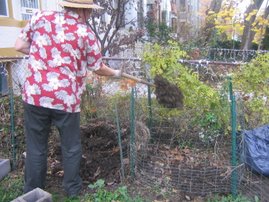
The producer and camerman spent about 45 minutes filming me talking about how easy it is to grow vegetables at home, and how much money you save on grocery bills. They shot me digging into the compost pile and planting potatoes. They even took a shot of our canned goods leftover from last year, and parted with a jar of green tomato mincemeat.

If you do happen to catch a glimpse of it, do let us know. My wife is always concerned that I'm not properly styled....

An Alternative to Farmed Salmon

Everybody sells it. But farmed salmon gets a big fat "avoid" from marine environmental groups such as the Monterey Bay Aquarium's Seafood Watch program. The reasons are many:

* Salmon are carnivorous. It takes three pounds of fish feed to create one pound of salmon, meaning
stressed fish populations are being further exploited to create farmed salmon. Salmon feed can also include wastes from poultry operations or genetically modified soy and canola.

* Because they are raised in confined areas, farmed salmon are ideal hosts for sea lice and other parasites, which they then spread to the nearby wild population. Chemicals used to treat salmon for sea lice pollute the ocean.

* Farmed salmon are highly prone to a host of diseases, requiring treatment with vaccines and antibiotics.

* Farmed salmon frequently escape, threatening wild populations.

* Farmed salmon build more fat than wild salmon, making them prone to accumulate more toxins such as PCBs. Eating farmed salmon can pose a health risk.

* Farmed salmon labeled "organic" in Europe should not be considered "sustainable." These "organic" farm operations are allowed to use chemical treatments for sea lice, for instance, and are still prone to fish escapes and other environmental damage. "Organic" salmon still requires enormous inputs of wild fish as feed.

*The Londong-based Marine Stewardship Council has certified as "sustainable" more than 2,000 seafood products, not one of them farmed salmon, even from their own back yard. They have certified wild-caught Alaska salmon.

So what's the alternative to farmed salmon?

I'm so glad you asked. Seafood Watch recently sent out a notice encouraging consumers to choose farmed Arctic Char instead. Char is in the salmon family and looks very much like salmon. But unlike farmed salmon, farmed char does not harm the environment or pose a risk to human health. Here's what "Seafood Watch" has to say:

"Arctic char are in the salmon family and native to the northern regions of North America and Europe. Though it's available wild-caught, char is typically raised in land-based re-circulating systems which reduce the risk of disease transfer, pollution and fish escapes.

"Like salmon, Arctic char are carnivores that require feed made from wild fish -- causing a drain on the ocean's natural food web. However, the amount of wild fish needed to produce farmed Arctic char is low compared to other carnivorous farmed fish like salmon and this one issue of concern does not warrant a lower overall Seafood Watch ranking."

The wild salmon fisheries of Alaska are still rated a "best choice" by Seafood Watch and are certified sustainable by the Marine Fisher Council. But if you are looking for something different, do try farmed Arctic char. And if your fish merchant isn't carrying it, ask her to start. Try poaching a char fillet and serving it with your favorite tartar sauce.

Friday, March 27, 2009

Don't Wait for a Community Garden Plot!

We don't publish many guest posts here at The Slow Cook (this may be the first). But this story was too good to pass by. Nat West, of Portland, Oregon, got tired of waiting for a community garden plot. So he went to Google's satellite map, located a vacant lot near his home and turned it into his own CSA urban farm.

By Nat West


I live in urban Portland Oregon on an average-sized city lot of 5000 square feet. That's 50 feet by 100 feet. My house takes up almost 1000 square feet, my garage another 750 square feet or so, and an always-shaded driveway about another 500. Throw in a grand old cedar tree on the southern neighbor's property, a nice deck to relax on during summer months, and I find myself happy to have squeezed in about 250 square feet of raised beds.

Now 250 square feet of good dirt produces a heck of a lot of zucchinis, cherry tomatoes, peas and lettuce, provided I plant intensively. But I'm one of the lucky ones because of the orientation of my property, the placement of the house on it, and the surrounding neighbors' structures and trees. Some of the properties on my block could not grow anything more than a few tomatoes in pots, no matter how much grass they gave up.


After a few years of growing on 250 square feet, I decided it was time to expand. I never had the room for voluminous crops like cabbage, winter squash, pumpkins or corn. And I would frequently prune my yellow crookneck squash to a single vine. I've even tried trellising beans, peas and tomatoes, but once I decided to seriously grow food for my family, not just pretty summer fruits, I simply had to expand.


So I did what most urban gardeners do when they find themselves in a similar situation. I found the closest community garden owned by the city and put my name on a waiting list 18 months long.

After mulling it over for a bit, I realized that an "18 month waiting list" is worse than a "twenty minute wait" at a swanky restaurant. The maître d' has no real idea how long it will take to get me seated. She's just guessing that table 22 will get up soon. But unlike eating a meal, gardening never "ends". After all, why would it? There's no forced-eviction after a couple years so everyone gets a chance. You can rent a plot forever, or even sublet it like rent-controlled apartments in New York. The likelihood of getting a plot is even slimmer since, in recent years, many home garden seed suppliers are selling more than they've ever sold before. Those seeds have to go somewhere, and I haven't notice people razing houses and chopping down trees in my neighborhood.

I concluded that I could not wait for a community garden space to open up. I had to find my own garden space.


The first thing I did was to think about my neighbors' yards. Some of my neighbors had patches of relatively unkempt grass. Would they mind if I killed the grass, tilled the dirt and planted vegetables? I would have to share some produce, but they also get out of mowing. And of course I would have to use their water for irrigation. I figured it wouldn't be too hard to put together three or four small parcels, each about the size of my own garden at home.


But as I thought about the daily effort and workload of managing multiple plots, and dealing with multiple people, I realized that it might turn into a lot of work very quickly. What if a neighbor cut me off in mid-season? Or what if a neighbor ate everything, thinking they were entitled? How many sets of hoes, shovels and wheelbarrows would I need to buy? I realized that these issues would have to be dealt with no matter what, but it was in my best interest to have the fewest number of plots as possible. Which meant that I needed to “go big” - find the largest contiguous plots I could.


Other than riding my bike around the neighborhood and keeping my eyes peeled while on walks, I used Google Maps’ satellite view, in high magnification. Starting at my house, I made concentric circles, searching block by block for empty lots or very large back yards. Using this strategy, I was able to quickly identify a number of potential sites that I would not have found had I been searching on foot.


Now that I had a list of nearby large yards and empty lots, I used Portland Maps, an online database of property records. Navigating through the maps, I was able to find the name and address of the owner of each property. The same information could have been found using public records at the county courthouse, but I saved an immense amount of time. In some cases, I also cross-referenced them in the phone book since the address on file with the county is oftentimes not a current address, especially in the case of empty lot owners.

I planned to contact them in person if I could not find the mailing information for a particular lot. I sent an introductory letter to the landowners, explaining who I was, where I lived, and what I wanted to do on their land. I got one response, for a full empty lot directly across the street from my house. 5000 square feet of flat, full-sun dirt, absolutely perfect.


The landowner had recently received a nuisance complaint from the city about the buildup of refuse on the lot. She was elated that I would clean up the lot and turn it into a garden. In exchange for the use of the land, I am providing her with approximately one CSA share of produce for 16 weeks. We drew up an agreement, and she promises to give me as much advance notice as possible should she decide to sell. She also offered me a lot four times the size of this one, about 20 blocks away, which I hope to use next year.


Eventually I came to the realization that my new lot is much better than a community garden plot. I did not have to wait 18 months, or for that matter, 18 years for a small plot. I pay no rent for my 5000 square feet, but I would have to pay rent for a fraction of that size in a community garden. Also, I get to manage crop rotations, soil amending, and pest management holistically.

Community plot gardeners have to either work together or more often than not, grow weaker crops beset by pests because they are surrounded by crops grown using different practices, oftentimes on depleted soils. Working to encourage more collectivism of community gardens would solve some of these problems, but why wait? I’m sure there are usable, empty lots around your neighborhood.


For another ingenious approach, read about Murray Hill Row-by-Row, an urban CSA started by a school teacher in Annapolis, Maryland, who got 22 neighbors to share their back yards to grow food. And for even more stories about how the food system is changing, check out "Fight Back Friday."

Thursday, March 26, 2009

Sustainable Seafood? Good Luck!

Studies indicate that the world's fisheries may be facing total collapse by 2048. Some 80 percent of commercial fish are already being exploited beyond or near their ability to sustain themselves. So imagine a world in which most of the world's governments are actively promoting the pillaging of oceans and even the best experts in the seafood industry can't agree on how consumers should go about deciding which seafood to buy.

Those are the lessons I drew from a sustainable seafood confab hosted this past weekend by the Smithsonian Institution's Natural History Museum and the American Institute of Wine and Food. Of course, most of the people were there for the food. They packed a Friday night cocktail reception with tons of ceviche, raw bar and various seafood stations. A lunch on Saturday was booked early. I attended two panel discussions Saturday that didn't quite fill the museum's Baird Auditorium. But many of the big guns were represented, including Monterey Bay Seafood Aquarium, the Marine Stewardship Council and the National Marine Fisheries Service. Three of D.C.'s premier seafood chefs were on hand--Bob Kinkead, Jeff Black and Barton Seaver. Alton Brown, as host, maintained a lively banter and injected a bit of humor.

All agreed that an attitude of "pillage and plunder" still prevails on the world seas. Fish are the only wild creatures still hunted commercially. Enforcement of environmental laws on the oceans is virtually impossible. Only a handful of countries--the U.S., Norway, Iceland, New Zealand, Australia--take sustainability seriously, while the Europeans, and especially countries such as Spain, are among the worst offenders. Everyone seems agreed that if anything is to be done about saving the planet's fish populations--and by extension the oceans themselves--consumers will have to step up and start playing a more active role by avoiding seafood that has not been sustainably caught. In other words, vote with your fork.

"Governments around the world have failed to save our oceans," said Steve Murawski of the National Fisheries Service. But miracles can happen when government,industry and environmentalists work together to allow individual species to recover and thrive. That is the best strategy for creating sustainable fisheries. For instance, the striped bass, once king of the Chesapeake Bay, was nearly wiped out. Then a moratorium was declared and now the striped bass is on top of its game again. Swordfish, also, are making a comeback in the Atlantic following strict regulations. And Murawski said that careful husbandry of resources is now producing some of the biggest sea scallops ever seen, right here in the U.S.

What I was most interested in knowing is how consumers can go about choosing sustainable seafood when information is often conflicting or hard to come by, and when so much of the seafood we see on restaurant menus or on display in the supermarket clearly does not fit the description of "sustainable." It gets even more confusing when you find chefs who proclaim to be sustainability advocates serving fish that otherwise would fall under the heading of "avoid" on the lists provided by the protectionists' leading lights.

What's going on?

Alton Brown, for instance, has become a big advocate of the lists formulated by organizations such as Monterey Bay Seafood Aquarium and Blue Ocean Instute. The lists, available online and as printed pocket guides, advise consumers which seafood is "best" (green), which is "acceptable" (yellow) and which we should "avoid" (red).

Unfortunately, lists such as these rub some chefs the wrong way. Jeff Black said, "it's very simplistic to say this is on a red list and this is on a yellow list." For instance, the Monterey Bay Seafood Aquarium's "Seafood Watch" program lists farmed salmon as "avoid." Salmon farming raises all kinds of environmental concerns. Black gets his from operations in Scotland and Ireland that have been certified as "organic" in Europe. Yet "organic" doesn't signify sustainable. Black counters that "if we stopped eating farmed salmon and just ate wild salmon from Alaska (which is certified as sustainable), the wild salmon would be gone instantly."

Both Black and Bob Kinkead argue that part of the problem is consumers' lack of interest in fish other than the familiar triad of tuna, swordfish and salmon. And there is the strong indication that in order to survive as going concerns, restaurants need to cater to customer desires by seeking out fish that might not qualify as certified "sustainable." Black said he has tried offering tilapia in his restaurants, for instance. Tilapia, a vegetarian fish, can be easily grown in sustainable aquaculture facilities. But while he can put it on the lunch menu, "people just won't buy tilapia for dinner," Black said.

"I have to be able to sell product that makes enough money to keep the business going," Black declared.

And watch out. The choices are likely to get even harder. Tim O'Shea, co-founder of a California business called Clean Fish, said small, artisinal fisheries are on the rise. They may be offering seafood you won't find on any list, or they may sell fish otherwise listed as "avoid" that are being raised or caught in what Clean Fish believes is a sustainable manner, but hasn't caught the eye of rating agencies such as the Marine Stewardship Council.

What these small operations offer, O'Shea said, is a great story about how individuals are fostering sustainability in microcosm, much like the small operators in cutting-edge agriculture who are producing fine cheeses and other products in an artisanal fashion. "The people are as hungry for the story as they are for the fish," O'Shea said.

But Carrie Brownstein, the Seafood Quality Standards Coordinator for Whole Foods Market, warned against buying into "good stories." Brownstein, who scours the globe investigating seafood producers and developing standards for Whole Foods said she has heard many "good stories" and advises consumers to stick with seafood that has been approved by a reputable rating agency such as Marine Stewardship Council.

Confused yet? I was. The question I put to the panel was, How far down in all these layers of information do consumers have to drill before they can be assured that they are purchasing "sustainable" seafood.

There was no satisfactory answer forthcoming. And as Bob Kinkead pointed out, he's been selling seafood for many years and the general restaurant-going public mainly is concerned about being served the fish they want, not what may appear on some environmental organization's green list.

"I care about these issues. And I know everybody in this room cares about these issues," Kinkead said. "But I've gotta tell you, most of the people who come into my restaurant could give a rat's patootie."

My own advice is, if you're not a sustainable seafood expert yourself, stick with the recommendations of "Seafood Watch",Blue Ocean Institute and the Marine Stewardship Council. And fear not: There are plenty of sustainable fish and shellfish to choose from. Among those you might not have heard much about before, try Pacific "black cod," or "Pacific cod," also sold as sablefish. Barramundi is a farmed fish, but make sure it comes with a U.S. label.

"It is everyone's patriotic duty to eat farmed oysters, clams and mussels," said chef Barton Seaver. Of course he's referring to shellfish farmed here in the United States, and especially in the cold waters of New England. But he's right. There's hardly anything more sustainable or economical--or tasty, for that matter--than a big bowl of steamed mussels.