Sunday, May 6, 2007

Weekend Update

Pepsi, the maker of soft drinks, Fritos and so much more junk food, has become # 1.

But it's not what you think. We mean # 1 in renewable energy.

That's right, the same company that would love to hook your kid on sugar and cheap carbs has jumped to the top of the U.S.Environmental Protection Agency's list of buyers of green power. This after PepsiCo announced plans to purchase one billion kilowatt-hours of renewable energy credits.

Pepsi is parntnering with Sterling Planet to spend $2 million funding wind, biomass and hydroelctric power to offset the energy used in its factories, offices and other facilities.

Pepsi beats out Wells Fargo and bumps grocer Whole Foods to the # 3 spot in the green energy race (or would crawl be the more appropriate term?)...

******
Monsanto would love to corner the market on where we get our food (meaning seeds), but a federal judge in San Francisco this week said not so fast.

U.S. District Court Judge Charles Breyer orderd a halt to Monsanto's sale of genetically modified alfalfa seed nationwide until the government can assess the potentional impact on conventional and organic alfalfa varieties.

The Center for Food Safety here in Washington, D.C., has sued Monsanto on behalf of farmers who are fearful that the genetically engineered alfalfa will hurt their own alfalfa crops.

Monsanto seeds have a way of finding their way into the fields of farmers who plant conventionally. The agribusiness giant then swoops down with its team of lawyers and sues the luckless farmers for growing Monsanto's patented seeds, which are engineered to resist one of Monsanto's other products, Roundup, the weed killer.

This is the first nationwide ban on a genetically engineered crop since these bio-freaks were first introduced in 1994 by way of the Flavr Sav tomato.
The U.S. Agriculture Department says it will conduct the ordered study. But the ruling represents the thinking of only one federal judge. We'd look for Monsanto to appeal.

*****
Last week it was author Michael Pollan weighing in on the Farm Bill. Now, two U.S. congressmen say they'd like to eliminate all those fat subsidies for things like corn and soybeans and replace them with programs to promote fresh vegetables.

The legislation introduced by Rep. Rosa DeLauro (D-CT) and Rep. Wayne Gilchrest (R-MD) represents wishful thinking more than a bill to create actual law. But maybe hope is growing. It certainly seems as though there is mounting public interest in this arcane governmental monstrosity known as the farm bill.

The congressmen suggest re-directing federal funds to enourage farmer's markets, direct farm-to-consumer schemes and other arrangements that make locally grown foods more available and affordable. Of course, all those things exist already. It's just that the federal government up to now has been more interested in supporting with tax dollars the pet concerns of agribusiness, which translates into foods full of cheap sugars and carbohydrates.

A fellow at Johns Hopkins University, meanwhile, has chimed in with his own take on the Farm Bill.

Scott Kahan, a physician and postdoctoral fellow at the Johns Hopkins, has published 13 books on medicine and nutrition. Writing in The Baltimore Sun, Kahan opines that the U.S. Department of Agriculture is simply schizophrenic in its policies, subsidizing agribusinesses that help make people obese, on the one hand, while designing supposedly healthy food pyramids on the other.

Some $20 billion, more than one-fifth of the Ag department's entire budget, "is sunk into a farm bill that supports many of the foods its recommendations warn against. At the same time, the department virtually ignores incentives to produce, promote and consume some of the healthiest foods: fruits and vegetables."

Kahan notes that very little federal money is used to advertise or support fresh produce. "This is one reason Americans don't eat fruits and vegetables. Although some surveys suggest we eat about four servings daily, this number is greatly exaggerated because French fries and potato chips are counted the same as spinach, carrots or broccoli. In fact, 25 percent of vegetables consumed in the United States are fried potatoes."

Is it any wonder Americans keep getting fatter when we can't tell the difference between broccoli and a French fry?

*****
The Canadian government may be getting ready to crack down on pollution from salmon farms in British Columbia.

According to a report in the Vancouver Sun, fish farmers foresee a moratorium on salmon farming expansion on British Columbia's north coast and the mandatory conversion of existing farms to closed-containment systems following a government review of the aquaculture industry.

One of the reasons we steer clear of farm-raised salmon is the threat of pollution and disease spreading to wildlife in the surrounding oceans. One recommendation of the committee studying the aquaculture issue could be to ban within three years all farming of fish in cages at sea.

Environmentalists would see that as a good thing....

Closer to home, kudos go to The Washington Post for an article on seafood sustainability in the paper's Food Section. The article reads like a roundup of material we've presented here at The Slow Cook, with an emphasis on the Patagonian toothfish (aka Chilean seabass) and some description of the sustainability programs at the Monterey Bay Aquarium and Environmental Defense.

The article's real focus is on a chef who recently opened a seafood restaurant called Hook in Georgetown. Barton Seaver is determined to offer only sustainable products and has developed a relationship with fisherman in Tobago who supply him with fish they catch on the hook (get it?).

Normally, chef-centric food coverage irritates us. But in this case it's a good thing. Certain chefs have been been leaders in the fight to save endangered ocean species.

Odd, though, that The Post never mentions that Patagonian toothfish, which Monterey Bay Aquarium still has on its "avoid" list, is sold openly and even agressively at the Whole Foods just five blocks from The Post's newsroom. Nor does the article mention the still controversial "certified sustainable" label that the toothfish at Whole Foods carries from the Marine Stewardship Council.

For the record, the MSC label is granted only to toothfish from the South Georgia fishery in the South Atlantic. Most toothfish otherwise is caught illegally--in other words, pirated.

*****
Finally, we here in the District of Columbia are mourning the devastation by fire of our beloved Eastern Market on Capitol Hill.

The historic building in which the market is (was) located was set ablaze and suffered extensive damage, probably as the result of an electrical fire. Come to find out there were all kinds of fire hazards at the market. And we just thought it had that cool, lived-in look.

Eastern Market, in continuous operation since 1873, housed a wonderful cheese shop, a first-class butcher or two, plus vegetable vendors and a funky lunch counter. On weekends, neighborhood residents would line up around the block for a breakfast of "bluebucks," the signature blueberry-buckwheat pancakes, while others shopped at the farmer's market stalls and flea market just outside the building.

City officials have vowed to restore the historic Victorian brick structure. Neighborhood acitivists are mobilizing as well. Meanwhile, vendors are looking for temporary digs at a site nearby, possibly in an empty school building.

We here at The Slow Cook wish the market a speedy recovery. Otherwise, where are we going to get the whole beef briskets we need for our Texas barbeque?

Saturday, May 5, 2007

We're in Garden Rant

One of my co-conspirators in the gardening universe is Susan Harris, an irrepressible blogger and gardening coach who also happens to be one of the co-authors of that hugely popular gardening blog, Garden Rant.

Garden Rant has made an impression in this country as well as across the Atlantic with its irreverent style and wide-ranging coverage of all things green and sometimes blooming. So I was completely flattered when Susan asked me to write about the front yard here on a busy corner in the District of Columbia that my wife and I are turning into an edible landscape.

I don't mind saying that my vegetable gardening and composting would not have occurred were it not for the inspiration of our farmer friends Brett Grohsgal and Christine Bergmark. I was blissfully ignorant of the importance of local farming until I met Brett and Christine. This blog, The Slow Cook, stands at that intersection of the soil in which we plant and the food that sustains us.

Susan's invitation to write for Garden Rant became an opportunity to meditate a little on what it means to be an urban farmer. As I've said before, food doesn't just happen. It takes a lot of work. I salute all farmers who work hard to take care of the earth and ensure that we have food on the table.

Go here to read The Making of an Urban Farmer.

The Gentle Art of Re-Heating

I know many of you are anxious to hear the results of the parents dinner last night.

It was a huge success, with many raves for a menu representing the work I've been doing with the kids in my "food appreciation" classes.

Besides the kids themselves, the stars were the fresh Kielbasa sausages that the kids helped me fill over the last couple of days, plus a sauerkraut that I had fermented using our bucket method and braised with onions, apples, juniper berries and carraway.

The kids have been learning to peel vegetables. Lots of peeling going on. Se we also served boiled parsleyed potatoes and glazed carrots with dill. And for desert, highlighting our exploration of certain whole grains, oatmeal cookies with dried fruits and chocolate chips.

I had been told to expect 40 for dinner, so I made enough for 60, knowing how these things go. The trick is not so much making the food. No, that's the easy part. The challenge was getting the food hot again without overcooking it once we arrived at the school.

My wife and I have spent some years in the catering business and catering is all about reheating food. Many wedding guests may not realize that their fabulous dinner was actually cooked two days ahead of time, then merely brought up to serving temperature at the appropriate moment.

Yet that's why caterers get paid the big bucks. Most of the food, especially the side dishes, are prepared well in advance then re-heated with sterno in tall aluminum proofing boxes. The proofing boxes roll of the catering trucks and cans of sterno are arranged on baking sheets and lit under the food.

Some items, such as expensive beef tenderloin, chicken breasts and fish filets, are too delicate to cook and reheat. More often than not, they've been "marked" on a hot grill to give the food a chic restaurant look. Then the cooking process is completed over the sterno.

Imagine the value of a chef who can finish off, say, 30 whole beef tenderloins to perfect medium-rare doneness at exactly the right moment to serve a hall full of wedding guests? The thought is almost frightening, yet this time of year it's done all the time.
Now we cater our own dinner parties at home. Meaning, no crazy chefs running around trying to cook a la minute, scaring the guests. We have the meal cooked ahead so we it can just warm in the oven while we enjoy a cocktail and gab with our friends.

The food for last night's event had been cooked and refrigerated in the kind of big aluminum chaffing containers shown in the picture above. But we didn't have any proofing boxes at the school where we were serving dinner. Our heat source was the school's stove and range top.

How then to get all this food hot enough to serve at the moment our parents were ready to eat?

That's where my wife, the catering chef, comes in.

The method we used was to separate some of the denser and colder items, such as the sausages and the potatoes, into separate containers. I had not taken any chances with the pork sausages. They were already cooked through, but they were really cold after being in the fridge overnight.

My wife placed two containers of sausages in the oven, set at 350 degrees. She put one container of potatoes, dressed with some butter, in a small warming compartment on the side of the oven. That left containers of sauerkraut, carrots and more potatoes to heat. We accomplished that on the range top, setting the aluminums over four burners plus a full-sized griddle.

You just keep a close eye on the food on top of the range, stirring often to make sure nothing burns.

When the time came to serve, we had an assembly line ready at our food prep tables. The kids lined up to take plates of food and deliver them to their parents. Within a few short minutes, everyone was eating.

And if you listen closely, you can hear the sighs and the moans over our delicious food.

"My son won't eat the Kielbasa I make at home," said the school nurse. "But he came home this week and said he'd eaten the best Kielbasa ever."

You'd be surprised what kids will eat when they make it themselves.

Friday, May 4, 2007

Stuffing Sausage

I challenged the kids in my "food appreciation" classes to stuff sausages for tonight's parents dinner and they came through like champs.

I've beeen teaching classic and even ancient food preparation techniques to my elementary school students, including things like fermenting sauerkraut, pickling and lately making sausages.

They are totally captivated by sausage making. They love to squish the meat between their fingers. And this week they got their first look at hog casings and my hand-operated press for filling the casings.

The casings fit over a long nozzle. A long handle attaches to a plunger that forces the meat into the casings. Pressing the meat requires a good bit of upper-body strength. Each of the kids got a turn, and there were cheers, hoozahs and squeals as the meat squirted into the casings.

Some of the little kids actually had to grab the handle with both hands and lift themselves off the ground to get the meat to move through the nozzle. But they did a great job. We made five dozen sausages during four different classes.

This job is best done with two persons, one to operate the press, the other to hold and guide the casings as they fill with meat. You then shape the sausages into links by pressing the meat this way and that with your hands. Pinch them off, then twist to finish a link. Twist in the opposite direction to finish the next link. And just work your way down the line in that fashion.

To separate the links, just snip them apart with a sizzors.

What we've made for tonight's dinner are fresh Kielbasa sausages with pork shoulder, fat back and plenty of garlic. We used a recipe from Bruce Aidells' Complete Sausage Book and the result was a full-flavored sausage that the kids were wildly enthusiastic over.

2 1/4 pounds pork shoulder (pork butt)
3/4 pound pork fat back
1/2 cup water
2 tablespoons finely chopped garlic
1 tablespoon kosher salt
2 teaspoons dried marjoram
2 teaspoons coarsely ground black pepper
1 teaspoon dry mustard
1/2 teaspoon ground coriander
Medium hog casings

Cut the pork and fat back into cubes to fit your meat grinder and process with a 1/4-inch plate (the size of the die in the grinder). In a large bowl, mix the meat with the other ingredients. Grind a second time. Press into casings and form into large links, about five inches long.

Kielbasa can be cooked fresh or smoke-cured. We cooked ours fresh. Use a small trussing skewer to poke a few holes in the sausages so they don't burst. Brown on a griddle or in a heavy skilled, then finish cooking in a 325-degree oven. The internal temperature of the sausage should reach 155-160 degrees, as measured by inserting an instant-read thermometer long-ways into the center of the sausage.

Thursday, May 3, 2007

Calling All Pork Butt

I was preparing to grind meat for sausages yesterday and for the second time in two weeks called my local Whole Foods for pork shoulder (aka pork butt) only to be told there wasn't any.

That's not a problem any more. We are so used to the local Whole Foods not having what we need that my wife has written into our address book the phone numbers for all three Whole Foods located here in the District of Columbia.

We're not dummies. We don't drive around looking for stuff. We use the phone. In fact, if I get to Whole Foods and can't find something, I just park myself at the "customer service" desk and ask a clerk to make the calls.

Last week when the nearest Whole Foods didn't have pork shoulder I found it at the store about three miles away. No big deal. They packed it up and had it waiting for me.

But this week, none of the Whole Foods stores had pork shoulder.

"They (meaning the local distribution center) never delivered any," said the meat clerk who answered the phone at one of the stores. "This has been happening for years. It doesn't matter if we order something. If they don't have it, they just don't bring it. They don't tell us they're not bringing it and they never give an explanation. It's just a mystery and it's very frustrating."

Frustrating for the meat clerk. I, meanwhile, am pulling my hair out. I can't make sausages without pork shoulder. I had to call the local Safeway, where the butcher (I'm being generous with the term) not only had pork shoulder, but trimmed it off the bone for me and put it aside under my name.

Sometimes I forget how friendly the people can be at our poor, old, run-down neighborhood Safeway.

My disappointment is that the pork at Safeway is the kind raised in a dim, stinky corporate factory, "the other white meat" bred to contain as little fat as possible and consequently missing what I am ultimately looking for: the flavor of pork.

Whole Foods, meanwhile, carries the Niman Ranch brand of pork, a beast that has been raised by independent farmers to be fat and happy in a more outdoor setting. Just by virtue of not having the fat bred out of it, and being allowed to live its life more like a pig and less like a hamster, the Niman Ranch pork has more flavor.

Which raises the question: Why in the world would the meat department at Whole Foods be out of pork shoulder in the first place? Other than perhaps the cheeks or the shanks, cuts you rarely see for sale to the public outside restaurants and specialty butcher shops, the shoulder is the most flavorful part of the pig. It's a standard item--or at least it used to be.

Yet a stroll along the typical meat counter these days reveals that America's taste for meats runs more in the direction of style than flavor. The modern, tricked-out meat case, all chrome and glass and awash in soothing fluorescence, has more in common with a Paris fashion runway than with a true butcher's display.

Pork tenderloin marinated two different ways. Fancy shish kabobs with multi-colored vegetables you know won't be cooked when the meat is well past done. Filet mignon at $25 a pound. Miniaturized lamb loin chops. Chicken sausages a dozen different ways. Giant pork chops stuffed like Thanksgiving turkeys. To gaze upon this stylized cornucopia of protein as like standing in front of a diorama at the natural history museum: so lifelike, yet no real life there, all soul drained away.

The selection looks like something dreamed up in an editorial meeting at Bon Appetit magazine, all glitz and glam with one important component missing: the flavor.

I'm yearning for squishy livers, glistening kidneys, funky trotters. I want to see slabs of smoked bacon, gnarly hocks, fresh pork bellies.

It's the absence of these products, the backbone of our meat tradition, that tells the tale of our modern appetite. Meat these days has mostly become just another delivery vehicle for the latest magazine sauce or fruit salsa. Our concept of carnivorous has been conceptualized to the point that we don't recognize any more where the flavor comes from if not from the tropical, out-of-season marinade foisted upon us in the latest installment of Food Network.

Our meat has been mango-ized.

Again, it is those busy chefs and food writers and editors, all the stylists and studio visualists, trying to justify their salaries and cook up another trend. The consumer in his hapless disconnect from tradition, his disassociation from collective memory, his alienation from any sense of season and place, follows along, cruising for his next recipe fix.

And that brings me to the ultimate paradox: I thought the fatty flavorful cuts were the trend. I thought Fergus Henderson had made it clear--finally and for for all time--that it is the shoulder and the cheeks and the shanks we should be eating. I thought Nose to Tail Eating was the breakthrough that had finally led us home again to where the flavor is.

Could I have been mistaken? Because again I must ask: How can Whole Foods be out of pork shoulder two weeks running?

Wednesday, May 2, 2007

Got Chives?

The chives are in full bloom here in the District of Columbia.

It is a highly conspicuous display from an otherwise inconscpicuous plant. Chives consist of stems, impossibly long and narrow and hollow stems. But once each season they terminate in this bombastic, purplish pom pom of a flower.

Bumble bees love to come sit and meditate on the chive flowers. I can't help stopping to admire them on my way out the door.

Chives may be one of the most poorly utilized of garden herbs. We remember them more for those stubby little pieces of tube that fall almost weightless out of a bottle that sits so seldom opened on the herb rack, sometimess tossed ignominiously into a bowl of cream cheese for a quick spread or dumped into an egg casserole as an afterthought.

Chives are, like onions, leeks and garlic, an allium or, more precisely, allium shoenoprasum, a relative of the lily. Chives are perennial, meaning they return in the garden year after year without any care at all. We have wild onions that look just like chives and pop up in clusters in the middle of our lawn every spring. It's a great convenience to be able to harvest something so fresh and flavorful so early in the year, when everyone else is still complaining they have nothing to eat but old Brussels sprouts.

Truth be told, I don't have a favorite recipe for chives. I use them just like everyone else: in dips or spreads, in omelets or other egg dishes. So I am making a proposal: Do any of you readers have a favorite chive recipe? Or, even better, a favorite recipe for chive blossoms?

Send it here to Recipe Central at the Slow Cook and we will be sure to share it.

Tuesday, May 1, 2007

Making Food is Hard Work

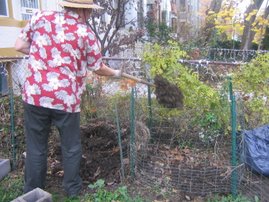
Another of the rites of spring is starting a new compost pile. I've been extremely busy lately--the warmer weather brings on a flurry of activities--and with the intermittent rains my lawn just kept getting taller and taller.

Not such a horrible thing, as the grass clippings make an excellent addition to the compost pile. The green clippings add lots of nitrogen to the compost, like and injection of lighter fluid--the bacteria love it, and heat the pile until it is steaming. That's very good for decomposition

But the process involves getting several different tools out of the garage, setting up a leaf shredding operation to add the necessary brown--or carbonaceous--matter to the compost for proper balance (I go around the neighborhood in the fall and collect the bags of leaves the neighbors leave at the curb). Mowing is no easy trick either, the lawn being interrupted by numerous vegetable and flower beds. And that still leaves the weeds that have begun to encroach on the beds. They need to be pulled, the edges trimmed and reshaped with a spade.

All of which is to say that before you can harvest those wonderful lettuces and greens and other vegetables, you have to work on the soil and the weeds and maintaining the tools. Food does not just happen, even though it might appear so if you are just strolling the produce aisle at the supermarket. There is much human toil involved. That is one of the advantages of shopping at a local farmer's market: You actually see the faces and meet the people who are responsible for bringing your food forth from the soil with their own labor.

Whenever I despair of the work involved in my food I remember Ward Sinclair. Ward for years covered the agriculture beat at The Washington Post. Then he succumbed and became a farmer himself. He bought a piece of land in Pennsylvania and sold his product at the farmer's markets here in the District of Columbia, as well as to several restaurants. He also started a column in the Post's food section called "Truckpatch."

To my mind, Ward's "Truckpatch" column was probably the best thing ever written about food in a newspaper. His personal essays brought home so vividly how the food we either take for granted or glamorize in slick magazines begins with the muscle and sweat of an individual who is committed to the soil. Most farmers, especially the small truck farmers we see in the farmer's markets, do not make a lot of money. They are just crazy about the work. And there is so much of it.


After all these years, one particular column Ward Sinclair wrote, republished in the book Truckpatch: A Farmer's Odyssey, sticks in my mind. It simply details all the chores that lay before Ward on one typical spring day as the new planting season approached and he contemplated his schedule.

Knowing how to plant a seed, nurture it, harvest it, and take the finished product to market is only a part of the demands of the truckpatch, he wrote. The to-do list requires the farmer to be mechanic, carpenter, supply specialist, labor negotiator and employer, writer and graphic designer, plumber, banker and a host of other arts.

Oh, it would be simpler to call in an expert and have the job done right. But there is neither money nor time enough for the farmer to rely on others. When a tractor goes dead, he can't wait on help from afar. When wind rips the cover off a greenhouse, it must be replaced immediately.


So the to-do list is the farmer's master. It determines how his time is allocated and in its cryptic code language reminds him every day that the work on the farm is never done if the place is to flourish and succeed.

Ward Sinclair, ran a farm near Dot, PA, with his partner, Cass Peterson. They started one of the first farm subscriptions, or CSAs, in the United States. Ward died too young in 1995. Whenever I think that growing food is too much work, I remember his words.