Showing posts with label New England. Show all posts

Wednesday, January 14, 2009

Steamed Brown Bread


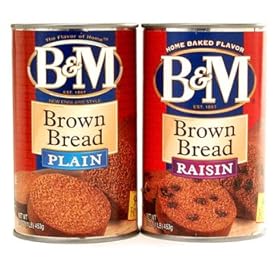
Steamed brown bread, a New England tradition, was a treat for us even growing up in the Midwest. We ate it out of a can (I never knew it any other way) and it was always something exotic and mysterious when it arrived on our dinner plate, almost on a par with getting chow mein carryout from the local Chinese restaurant.

My memory is of the B&M brand of canned brown bread. This is a proud company from Portland, Maine, that first opened for business in 1867 and was canning corn long before it thought to can brown bread or Boston baked beans, the company's most important product. B&M has since been bought up by a succession of bigger food corporations over the years. But the brand and the factory still exist in Portland. The beans, cooked in open pots in brick ovens, come in a can as well as a jar uniquely shaped to look like a classic bean pot.


Making steamed brown bread at home is simple, but the technique may be new to you as it was to me. Instead of baking in an oven, the bread cooks in a pot of boiling water, usually in some sort of tin can or similar mold. (You can even make it in a flower pot). To get the can, I had to buy a pound of coffee at the supermarket. We don't normally get our coffee in a can anymore. Then, after I had mixed the batter, I found that the recipe I was following in Aliza Green's The Bean Bible was much more than enough to fill the 1-pound can she called for. I see now that James Beard, who included an almost identical recipe in Beard on Bread, called for "cans," plural.


An iconic New England food, steamed brown bread typically calls for three types of whole-grain flours, starting with rye flour, corn meal and either whole wheat, graham flour, oat flour or, in my case, since it was what I had in the pantry, barley flour. The batter must contain molasses--a staple ingredient in bygone New England--to give the bread its distinctive color and sweetness. Baking soda and buttermilk react to give the bread its rise. Traditionally, it can be made plain or with raisins.


If you are using coffee cans to make the bread, you'll need to grease the inside or line them with parchment paper. You'll also need a tall pot ( or pots) to steam them in, with a wire rack or empty tuna cans or something similar (I used stainless baking rings) to put at the bottom of the pot so that the bread is not touching the heat source. Since I only had one coffee can, I improvised at the last minute with a small, high-sided cake pan. It worked just as well. Either way, the mold should be covered with a double layer of aluminum foil tied securely with a length of butcher's twine.


To make your bread, mix together 1 cup rye flour, 1 cup cornmeal, 1 cup oat flour (or substitute barley, whole wheat or graham flour), 2 teaspoons baking soda and 1 teaspoons salt. In a separate bowl, mix together 2 cups buttermilk and 3/4 cup molasses.


Pour the buttermilk mixture into the dry ingredients and mix well. Pour the batter into 2 greased, 1-pound coffee cans (I used spray canola oil) or molds lined with parchment paper. Each can should be about 2/3 full. Place the cans into tall pots with a wire rack or empty tuna cans on the bottom. Fill the pots with water to a depth halfway up the side of the bread can (or mold). Bring water to a boil, reduce heat and continue boiling for about 2 1/2 hours, or until a skewer inserted into the bread comes out clean. When the can is cool enough to handle, simply remove the foil, invert the can and tap the bread out onto a cutting board. You may have to use a thin knife initially to separate the bread from the inside of the can.


Note: Aliza Green suggests cooking the bread 2 1/2 to 3 hours. Meanwhile, James Beard calls for cooking the bread 1 1/2 to 2 hours. Quite a difference. We cooked ours for2 1/2 hours and it seemed fine. If two loaves seem like too much, cut the recipe in half and just make one.

My wife thinks the bread gains from sitting a day or two before being eaten. We agree that the only way to serve it is with a generous slather of cream cheese and preferably a bowl of Boston baked beans.

Tuesday, January 13, 2009

How Do You Bake Your Beans?

Boston baked beans and steamed brown bread spread with Philadelphia cream cheese. Isn't this a dinner we all grew up with?

The memory leaped to mind when I went searching for bean recipes yesterday. It's high time The Slow Cook gives more attention to legumes, meaning dried beans of one sort or another. Beans are packed with nutrition, and one of the best sources of calories. No fat, lots of fiber. What more could you ask for? Plus, you can easily grow them in your home garden, even right here in the District of Columbia, about a mile from the White House.

I cracked open my copy of The Bean Bible, by Aliza Green. It's overflowing with excellent background information about beans. Unfortunately, the first three recipes I tried were failures in one way or another. Not by a little. By a lot. Green's recipe for Boston-style baked beans, for instance, took me at least 10 hours to cook. There was simply too much liquid in it. Mea cupla for assuming that a "bean bible" is actually the last word. I have since returned to my library and done some additional research.


Fact or fiction: Beans need to be soaked before cooking.


Some cooks insist on soaking beans to make them more digestible,or simply to reduce the cooking time. I usually soak mine overnight. Green advocates a hot soaking and a pre-cooking process, wherein 1 pound of Great Northern beans are brought to a boil in 8 cups of water and cooked for 2 minutes, then taken off the heat and allowed to soak for 1 hour. The beans are then drained, covered with another 8 cups of water, brought to a boil and simmered for 1 hour. All this before any other ingredients are added. Meanwhile, The New Best Recipe, the kitchen tome put out by Cook's Illustrated, says their numerous trials showed that soaking or pre-cooking is completely unnecessary.


Fact or fiction: Salt added too early to beans will toughen the skin, preventing them from absorbing liquid.


Aliza Green contends that both salt and sugar have the toughening effect. Hence her convoluted process of pre-soaking and pre-cooking her beans. Harold McGee, meanwhile, writing in his seminal On Food and Cooking, says salt does slow the absorption rate somewhat, but that beans pre-soaked in salted water actually cook faster. Furthermore, acids and sugars strengthen the cell walls of beans. Hence molasses--with its classic mix of acid and sugar--is particularly good at helping beans keep their shape during a long cooking process.


Boston baked beans traditionally start with a small white bean (smaller than Great Northern, but that's what I had in my pantry), along with molasses, dark brown sugar, dry mustard and salt pork. These are all classic ingredients that permeate the cuisine of New England. How to finish the beans becomes a matter of taste, and deciding how much of each ingredient to use.


The baked beans I made following Aliza Green's instructions eventually turned out fine--a dense mass of dark beans with a strong molasses flavor. They were much closer to the baked beans I remember from childhood than the beans from a can of Bush's Boston Recipe Baked Beans, which to me tasted like ordinary beans. (But then Bush's Beans hail from Tennessee. What do they know about Boston baked beans?) You can see the difference in this photo--my beans on the right, Bush's beans on the left.


I like the Best Recipe approach, which offers some simple refinements to the classic recipe. For instance, they added diced onion for flavor (Aliza Green calls for placing a whole onion studded with cloves in the bean pot). Also, they suggest cubing the salt pork and browning it before mixing it with the beans. Again, more flavor, compared to the traditional method of simply laying a scored slab of salt pork on top of the beans. They prefer using prepared mustard rather than dry mustard on grounds that most home cooks are more likely to have a jar of prepared mustard on hand. And they like a bit of cider vinegar added to the mix to cut the sweetness of the molasses.


So where does that leave us? I'm not exactly sure, since I liked the end result of Aliza Green's method, but I would gladly incorporate some of the suggestions from Best Recipe. If you pre-cook the beans as described above, proceed by lightly browning 6 ounces salt pork, trimmed of any rind and cut into small cubes, at the bottom of a heavy pot or Dutch oven. Add 1 onion, finely diced, to the pot and cook until the onion is soft, another 8 minutes or so. Remove from heat, skim off excess fat and reserve.


In a large bowl, mix 3/4 cup molasses with 1 1/2 cups dark brown sugar, 1 1/2 tablespoons prepared brown mustard, such as Gulden's, 1 tablespoon ground ginger, 1 teaspoon salt, 1 1/2 teaspoons ground black pepper and 4 cups water.


Pour the prepared beans into the pot with the salt pork and onion. Mix well. Add the molasses mixture,which should easily cover the beans. If not, add more water. Cover the pot and place it in a pre-heated 300 degree oven and cook for about five hours, or until the beans are almost cooked through, adding water to the pot from time to time as needed. Remove the lid, stir the beans, and continue baking until the beans are completely tender and all of the liquid has been absorbed or cooked off. What you should have is a thick muddle of beans, not a sloppy bean soup. If necessary, continue baking with the lid off until any excess liquid is eliminated. Finally, stir in a tablespoon of cider vinegar.


If you do not pre-cook the beans, Best Recipe calls for adding 9 cups of water to the molasses mix and cooking for 4 hours, then removing the lid and baking another 1 hour.


Note: Cooking times for these baked beans are all over the map. I consulted all of my New England cook books, as well as the Fannie Farmer Cookbook (Farmer, a real person, ran the Boston Cooking School for a time around the turn of the 20th Century). Most call for a cooking time of six or seven yours. Be your own judge.

But enough of how I bake my beans. Let's return to the original question: How do you bake yours?

Tomorrow we'll be looking at steamed brown bread. It's hard to beat the stuff out of a can for childhood memories. But if you can't find it at the store, you can make your own.