Showing posts with label food prices. Show all posts

Thursday, June 12, 2008

The End of Food

Paul Roberts, author of the latest book to be titled "The End of Food," was at the Washington Ethical Society for an interview last night. I was not. Twice I ventured into rush-hour traffic for a trip that might take 15 minutes at any other time of day and twice I turned around and went home, stymied by roads clogged with vehicles headed in the same direction. Finally I gave up: It seemed preposterous that I should be spewing carbon to hear a talk about how our industrial food system is foundering over the high price of oil.

Fortunately, Roberts also appeared on the local public radio station earlier in the afternoon. Author of a previous book titled "The End of Oil," his riff on food could not have been better timed, as an entire nation agonizes over the loss of its tomatoes because of a salmonella bug that proves impossible to trace.

Deadly tomatoes and spinach, millions of pounds of tainted beef recalled, mad cow disease--such is the price of a food system that has lost all sense of human scale and accountability. And as we wave goodbye to cheap oil, food prices spiral out of control, threatening the lives of a billion people or more.

The so-called "Green Revolution"--based on artificial fertilizers and diesel powered machines--was supposed to feed the world. It brought us an abundance of cheap food but now, barely two generations later, we are tallying the costs: soil destroyed, air and water fouled, family farms decimated, rural communities obliterated, Third World farmers facing starvation. The food itself, we learn, is not good for us. It's making us fat and unhealthy. In some cases it is lethal. Corporations have made out like bandits feeding us transfats, bovine growth hormones and high fructose corn syrup. As recently as a year ago you could have bought stock in Monsanto and doubled your money. But for the average eater, cheap food has come with a terrible price. And in the end, the world still does not have enough.

This does seem to be the ultimate paradox: As a society, we have forgotten how to feed ourselves without destroying the planet. In a competition for people's bellies, the profit motive rules over the collective good. Ten thousand years of learning agriculture have left us not much wiser, staring over the edge of a precipice.

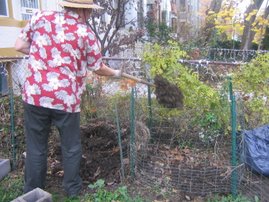
For a longer take on Robert's book, I suggest a recent New Yorker essay. The issues are so big, they've left a pall of silence over the political landscape. Our "leaders" seem helpless and without a clue. The public, meanwhile, is sleep-walking into dark and dangerous territory, while the popular media are just now coming to grips with issues that were foretold decades ago. They scramble to write stories about people like us, people turning their yards into vegetable gardens.

There's never been a better time to park your car in the garage and putter with your tomatoes.

Sunday, December 23, 2007

Weekend Update

First it was the food banks that were running out of food. Now, as Christmas approaches, we learn that the entire planet is being squeezed.

Yes, using food plants to make ethanol and other biofuels is partly behind it. But the economic booms in India and China are also to blame, creating new wealthy classes who want to eat meat. Food grains are going to feed livestock instead of people. The price of food is rising dramatically. So is the price of fuel used to grow food and ship it from place to place.

There now looms "a very serious risk that fewer people will be able to get food," particularly in the developing world, says Jacques Diouf, head of the UN Food and Agriculture Organization.

The agency's food price index rose by more than 40 percent this year, compared with 9 percent the year before. Prices of wheat and oilseeds are at record highs. Wheat prices have risen by $130 per ton--or 52 percent--since a year ago.

"We're concerned that we are facing the perfect storm for the world's hungry," said Josette Sheeran, executive director of the World Food Program. "You can debate why this is all happening, but what's most important to us is that it's a long-term trend, reversing decades of decreasing food prices."

Global warming threatens to make matters only worse, bringing droughts to areas most in need of sustenance.

Let's keep those less fortunate in mind as we celebrate the holidays.

Bon appetit and Merry Christmas...

Wednesday, April 18, 2007

Cars vs. Food: The Corn Wars Chapter II

It's official: the demand for ethanol to power automobiles is jacking up the cost of our food.

The Wall Street Journal this week details how a doubling in the price of corn largely attributable to a diversion of the grain into a growing ethanol stream is boosting the prices of meat, poultry and cereals in the grocery aisles.

The U.S. Department of Agriculture estimates that food prices will climb up to 3.5 percent this year. But other analysts think the spike could be more like 4.5 percent. And, unlike storms, droughts and other kinds of crop-damaging events, the pressure from ethanol on the corn supply is not a temporary event. Some economists think the government's push for ethanol production to reduce our dependence on a precarious supply line of foreign oil could stress food prices for the next 10 years at least.

The price of corn is now $4 a bushel, the highest it's been in a decade. Some food manufacturers may just be taking advantage of the higher cost of corn to boost prices and increase profits. But there is already evidence that meat packers are paying more for beef and that ranchers are sending their steers to market earlier than usual to avoid higher feed costs.

The CEO of Tyson Foods, the largest U.S. chicken producer, told his shareholders in February: "We have no choice but to pass along the higher costs to our customers who then pass along their higher costs to consumers."

The USDA estimates that U.S. farmers, lured by the gold in corn, this year will plant 91 million acres of corn, the most since 1944. But that means they will be planting less wheat and soybeans, which will drive up food costs elsewhere.

Corn is practically ubiquitous in our country's food chain, appearing in everything from cattle and chicken feed to corn flakes and the high fructose corn syrup in soft drinks. The move to ethanol has also led to a tortilla crisis in Mexico, as discussed in an earlier post.

Meanwhile, the Bush administration in the six years it's been in office has been loathe to do anything to increase fuel efficiency standards. Somehow, America just has to maintain its happy motoring uptopia, even if it means paying more for food.

Is there something wrong with this picture?

To read the full text of the Wall Street Journal report go here.