Thursday, May 31, 2007

Classic Strawbery Shortcake--It's a Good Thing

All year the kids in my "food appreciation" classes have been bugging me to make something sweet. And all year I've been the tough taskmaster, keeping them focused on things like corn and cabbage and sausages.

Well, the strawberries are in and they're irresistible. And fast. And easy.

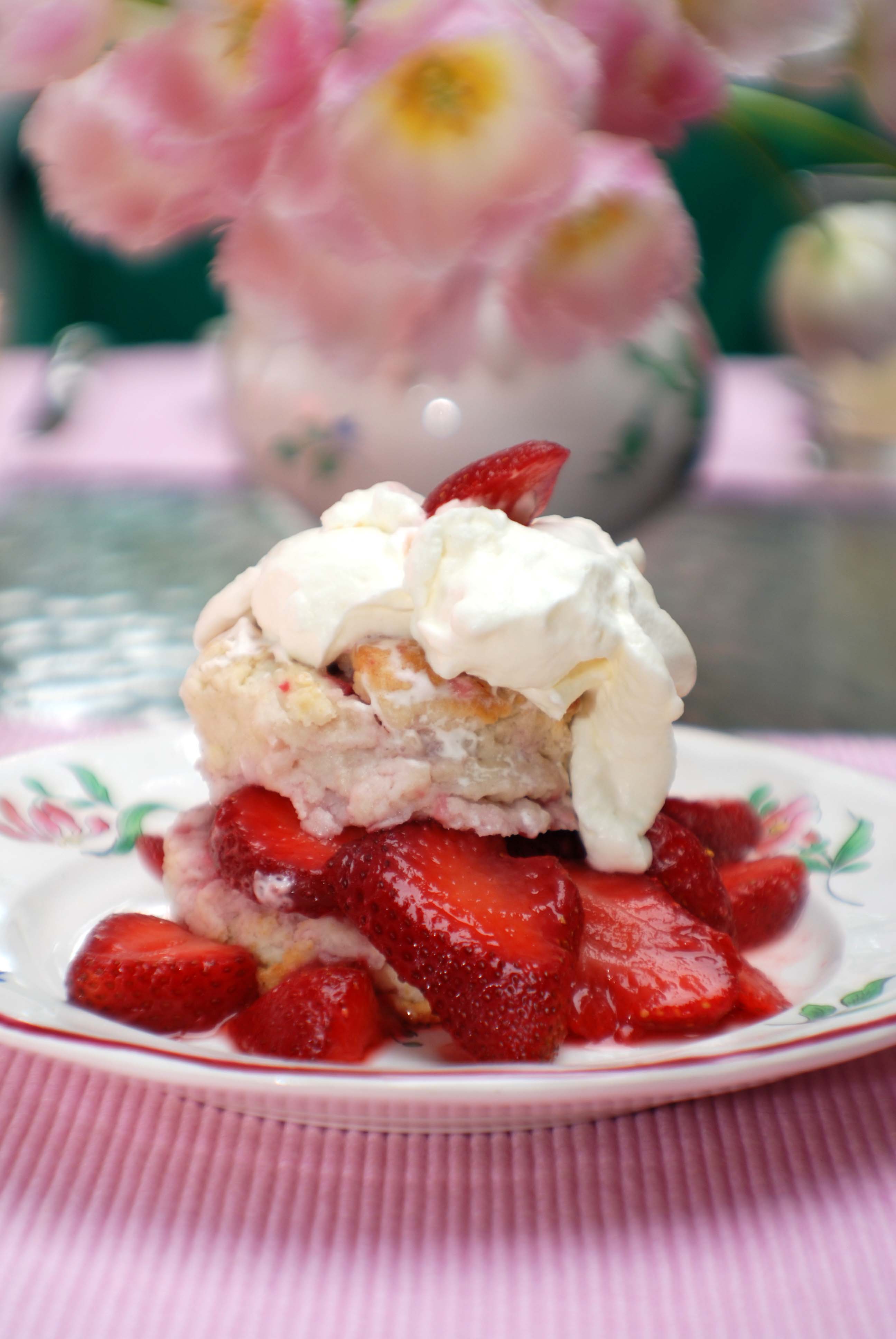
Perhaps one of the best desserts in the world, and fitting all of the above descriptions, is strawberry shortcake, pictured here in a photo from the Beyond Wonderful website.

The first settlers found Native Americans eating strawberries. It wasn't too many steps to combine them with a quick, chemical-rising bread, in this case called "short" cake because of the fat (nowadays usually butter or vegetable shortening or a combination of the two) that is incorporated in the dough.

Shortcake has a venerable history. John Thorne, author of the Simple Cooking newsletter, says the dessert has origins in Great Britain but is truly American. It started as a "dense rich concoction made from flour, butter and sugar," but sometime in the middle of the 19th Century, after the invention of chemical rising agents, Americans went wild for biscuits.

Now, shortcake simply means "the richest-tasting biscuit possible," and certainly not that spongy nonsense you so often see stacked next to the strawberries in the supermarket this time of year.

The cake itself, sometimes made on top of a griddle in days past, should be savory, not sweet. In fact, a real shortcake "is a mouthful of contrast," says Thorne. "The rich, sweet cream, the tart juicy berries, and the sour, crumbly texture of the hot biscuit all refuse to amalgam into a single flavor tone, but produce mouth-stimulating contrasts of flavor--hot and cold, soft and hard, sweet and tart, smooth and crumbly."

Strawberry shortcake is our go-to dessert this time of year. To serve six, first trim about a pound of ripe strawberries and slice into quarters. Mix with about one tablespoon granulated sugar and mash roughly with a potato masher. Flavor with a few drops of vanilla extract. Then slice a few more strawberries into the mix. Refrigerate at least an hour, allowing the strawberries to macerate. The sugar will draw the juice out of the berries and make a nice sauce.

For the the biscuits, we use the classic recipe out of the Joy of Cooking. (In fact, the binding of our copy is broken at page 632, where the recipe begins.) Note that when making biscuits you want all of your ingredients and tools chilled if possible so that whatever shortening you are using stays firm in the mixing.
To wit:

Preheat oven to 450 degrees.

Sift (or mix) into a bowl 1 3/4 cups all-purpose flour, 1/2 teaspoon salt, 3 teaspoons double-acting baking powder. Cut in (with knives, forks or fingers) 4-6 tablespoons (I use 5 tablespoons) well-chilled butter, shortening or a combination. Work the flour and shortening briskly but not too much, until it is a grainy consistency. Add 3/4 cup cold mild and stir until just combined.

Biscuits don't want to be kneeded hardly at all. Some chefs, looking for a light and airy result, just push the ingredients until they hold together. So turn out the dough onto a lightly floured surfaced and flip it around a few times, pushing it together, until it holds. It should be soft and light. Now use hands or a rolling pin to press it out to a thickness of 3/4- or maybe 1 inch. The thicker the dough, the taller the biscuit (and the fewer of them).

Cut with a biscuit cutter dusted with flour. Place the rounds on an ungreased baking sheet. Brush the tops with milk and dust with sugar (granulated or crystals). Bake 12-15 minutes, or until just lightly browned.

While the biscuits are cooling a little, whip your cream with sugar to taste. Now split the biscuits in half. Heap some strawberries with juice on the bottom half. Add a dollop of whipped cream, replace the top of the biscuit and serve.

As simple as strawberry shortcake may be, people always swoon over it. Kids will lick the plate.

Wednesday, May 30, 2007

So Much for Radishes

Talk about your global warming...

The radishes have started bolting and it isn't even summer yet. When they go to flower, the radishes turn tough and woody. Time to get them all out of the ground and start eating.

For that matter, all of my brassicas have bolted. That would include the mizunas, the mustard greens, the pac choi and tat soi. Even the Brussels sprouts, hardly more than juveniles, are sending up flowers.

The lettuces, thankfully, are still going strong. But for how long?

Is it possible to be so busy gardening you don't have any time to cook what you're growing?

That seems to be the case here. Time to get the tomato seedlings in the ground, plant more beans. I'm always a month behind it seems.

Tuesday, May 29, 2007

Slow Cook on the Air

The Slow Cook put on his gardener's hat today and joined a lively discussion on Pacifica Radio (WPFW 89.3 FM in the District of Columbia) about the effects of global warming on gardening.

Highlight of the hour: a U.S. Department of Agriculture official acknowledged that the department's mapping of new hardiness zones, based on the latest climate data, has been delayed because the mappers are in Iraq.

My job: to explain how gardeners can reduce their carbon footprint and be friendlier to the planet.

Plant more trees! Compost! Cut your grass higher (and while you're at it, switch to an electric mower and leave the clippings on the lawn.)

Full text of the story can be read on the D.C. Urban Gardeners news blog here.

Monday, May 28, 2007

Update for Memorial Day

Really, guys, everything's going to be okay!

With those words, Chinese officials tried to assure U.S. consumers and the rest of the world that not all food products emanating from the planet's most populous nation are tainted with noxious chemicals.

But no sooner had they gotten the words out than a strange ship was discovered floating abandoned off the China coast. When authorities boarded the vessel, they found that it contained thousands of exotic and endangered animals headed for the Chinese mainland and its hungry market.

Not only do the Chinese eat almost anything that walks, they also use body parts from rare beasts in their medicines. Thus, species such as the strange pangolin--a mammal with scales, pictured above--have been consumed to near extinction. The meat of the pangolin is considered a delicacy, while its scales are thought to help mothers breast feed.

Which just goes to show that it's not only the stuff coming out of China that we need worry about. The pangolin population has been wiped out in China, Vietnam, Laos and Cambodia.

Other animals on the ship included leatherback turtles, monitor lizards, Bazilian turtles. And there was a cache of bear paws. The animals were badly dehydrated, many near death. They were taken to emergency clinics to be revived.

"Unfortunately, this is all too common," said an official with Traffic Southeast Asia, a group that monitors illegal trade in endangered species. "This trade is a far bigger threat to these species than habitat destruction."

A quick check found that restaurants in China were still serving pangolin, but only for large parties. The animal normally weighs more than 20 pounds.

"We serve it in a hotpot," one waitress was quoted as saying. "That's the tastiest way."

Meanwhile, Associated Press reported that a frozen fish product from China labeled monkfish was being recalled because it may contain a deadly toxin.

Two Chicago-area people who ate the fish became ill and tests showed the fish contained tetrodotoxin. Tetrodotoxin is normally associated with the deadly puffer fish. Nearly 300 22-pound boxes of the "monkfish" were distributed in Illinois, California and Hawaii.

The Chicago couple became ill after eating soup containing the fish. We say, Good to know!

And in a double meanwhile, exports of fresh produce from China are growing by leaps and bounds, reports Business Week.

For instance, in 2000, China accounted for 1 million pounds, or less than 1%, of all U.S. fresh garlic imports. By 2005, China dominated that market, exporting 112 million pounds, or 73%, of the total garlic import market. The same goes for strawberries: China exported just 1.5 million pounds in 2000 and now exports 33 million pounds to the U.S, according to Business Week.

Large chains such as Wal-Mart love it that they can depend on China to supply produce year-round. The trouble is, traveling long distances means that any harmful organisms in the raw products have that much more time to multiply and grow.

U.S. authorities are now considering whether to allow China to raise and export poultry here.

Should we be worried?


*****


How much do fishing pirates hate environmentalists?

In case there were still any doubts, a group of seven French vessels that had been observed illegally fishing with drift nets in protected Mediterranean waters set upon the catamaran vessel being used by researchers and photographers from the environmental protection group Oceana.

Oceana said the incident occurred in the Gulf of Leon north of Corsica. But we'll let the group's press release speak for itself. It is gripping in its detail, especially the part where the fishermen drop trow and flash the photographers:

"After two weeks of conducting research in the Gulf of León and to the north of Corsica, on Monday morning the Oceana Ranger was encircled by a fleet of thonaillers (French fishing boats) 25 miles south of Saint Raphael. The fishing boats, which had come from various locations, initiated their attacks by firing a flare at the research vessel from the fishing boat Gallus, and then tried to provoke collisions between the catamaran and the fishing boats, all of which were moving at high speeds in an operation coordinated by the Orchidee II and Santa II. Several of the boats repeatedly threw ropes tied to buoys into the water to entangle them in the propellers of the research vessel’s two engines, which had to thus halt its voyage. Then, the fishing boats surrounded and tied up the Oceana Ranger. The fishermen, some armed with boat hooks and displaying their genitals, threatened to board the catamaran unless the cameras were handed over."

The environmentalists were finally rescued when government helicopters flew to the scene.

Typically, the drift nets are used to capture the now-endangered bluefin tuna and swordfish. We say, Have you tried Alaskan halibut?


****


Did you ever doubt that agri-business has friends in high places?

The U.S. House subcommittee on Livestock, Dairy and Poultry is considering adding language to the 2007 Farm Bill that would bar states or localities from prohibiting any food or agricultural product that the USDA has deregulated.

The move to pre-empt the power of localities to regulate food and agriculture products is aimed mainly at genetically engineered crops, in which companies such as Monsanto have an intense interest, to go along with their incredible lobbying power.

The Center for Food Safety reports: "This would wipe out the restrictions passed by voters in four California counties and two cities, and could limit the powers of the California Rice Certification Act and its ability to prohibit the introduction of GE rice varieties. Local and state laws pertaining to GE crops have also been passed in Colorado, Florida, Hawaii, Idaho, Maine, Minnesota, Nebraska, North Carolina, Oregon, South Dakota, Vermont, Washington and Wisconsin. All of these democratically enacted laws are threatened by this language."

It's a familiar tactic by big business. If local governments pass something they don't like, they just go to their friends in the state legislature and get laws passed saying localities can't trump state laws. And if states pass a law they don't like, they just cozy up to their friends at the federal level.

Ain't democracy grand?


****


One reason there isn't more locally grown food is that local farmland has been paved over in favor of housing developments and strip malls.

In Richmond, British Columbia, this week a standing-room crowd turned out to support the idea of a 136-acre farm in the town center. Actually this was just meant to preserve the status quo, because the farm area had already been established under the Agricultural Land Reserve, a provincial program enacted in 1973 to protect farmland near rapidly growing urban areas.

The 100-Mile Diet site reports that as Richmond grows, property values increase. The town council is eyeing the farm site for possible development and is pushing to have the land removed from the ALR.

“If it wasn’t for the ALR, all of Richmond would be paved already,” said one resident in the crowd.

Something to keep our eyes on...


****

Finally, there's a long takeout in the Columbia Journalism Review about coverage of the food movement, local versus international, organic versus pesticides, small versus big.

Many words are spent dissecting Michael Pollan and his Omnivor's Dilemma. One wishes the author were a little more knowledgeable about how farming really works, about the value of healthy soil, crop diversity, plant ecology. He labors under the usual misguided assumptions that the only way we can grow enough food to feed everyone is to douse farm fields with artificial fertilizers and pesticides, and recycles fears that we will probably starve without industrial nitrogen and fossil fuel-based pesticides.

The author is so busy trying to locate the fault lines in Michael Pollan's thinking that he never really pursues the opening theme of the piece, namely, that the reading and eating public could use journalism that considers food from a global perspective.

For instance, why does the "Food" section in the local newspaper seem utterly divorced from the real world, serving mainly as a recipe exchange and a shill for local chefs? Why is information about food contamination, crop subsidies, zoning issues, free trade pressures, the success or failure of local farms, etc., found only in the news pages or in the business section?

If we knew more about where our food comes from, how it is manipulated by the interests of international corporations, how our government encourages the large scale production of unhealthy food that destroys our soil and water, we just might start adding these to the cost of our supermarket bill, rather than trying to parse out the price of healthy, locally produced food.

Lurking in the debate is the question, Has our infatuation with the automobile and the mindless sprawl it encourages taken us to a point where there just isn't enough affordable land to return to a system of healthy, local agriculture? Or, will the converging trends of overpopulation, fossil fuel depletion and global warming deliver us to a place that looks like today's Cuba, where the collapse of the Soviet Union has, of necessity, meant turning every local patch of soil into a vegetable garden?

Maybe getting too much of a bad thing will, in the end, take us to where we really want to be.

You can read the complete CJR piece here.
Sunday, May 27, 2007

Dead Chefs and Hot-Smoked Kielbasa

Time now for our annual (sometimes) James Beard dinner, re-christened Dead Chefs Dinner so as to honor the passing of Julia Child as well.


In years past this has turned into quite a formal affair with many courses, many changes of plates and wine glasses and generally more food and drink than a person has any right to consume at one sitting.

Everyone is expected to bring a dish somehow connected to the departed chef(s) in question. For some reason I was swept away by the idea of making sausages. I didn't have a sausage recipe from either Beard or Child but I was pretty confident they would have enjoyed these sausages, even if it meant bending our rule a little.

(However--and I want to state this for the record--in search of something to hold the water bath inside the smoker since the metal bowl that came with the smoker seems to have sprung a leak, I did use a cake pan that once belonged to James Beard himself. I swear I am not making this up. We also have a copper colander that once belonged to Liberace.)

Originally I was just going to brown the sausages on the stove top and finish them in the oven. But summer is fast approaching and a little voice whispered "smoker" in my ear. So I had a quick consult with two of my sausage references--Bruce Aidells' Complete Sausage Book and Michael Ruhlman's Charcuterie--then set up the smoking unit in the front yard where passersby would get a good whiff of sausage and hickory smoke.

I had ground and stuffed Kielbasa over two days previous. My only question was about the legitimacy of smoking them. I don't claim to be an expert in this area. In fact, I am fairly new to sausage making. I have made Aidells' fresh Kielbasa on several occasions already, though. It's an excellent recipe with lots of garlic, marjoram, dry mustard and coriander. A very full-flavored sausage.

Kielbasa is typically smoked, but I'd venture to say that what you see in the supermarket has been prepared using a "cold smoke" method, where the meat never gets close to the actual fire and has been treated with some form of preserving salt. In the hot smoking process, the temperature inside the smoker reaches about 215 degrees (at least it does in my smoker) and the finished temperature of the meat is 150 degrees or more. No preservatives are required, although you can add them if you like the flavor.

I soaked a small bucket-full of hickory chips overnight, then set 6 1/2 pounds of finished sausage (I did not bother to twist it into links) on the two grates inside the smoker. The sausages were finished in about two hours, measuring for doneness by inserting an instant-read thermometer lengthwise into one of the sausages.

Meanwhile, our farmer friend Mike Klein had stopped by the day before with two pounds of fresh strawberries. It's been a very dry spring so far, this after a balmy January and a record-setting cold snap in April. Mike declared it perfect weather for strawberries, although farmers in our area around the District of Columbia are warning that their fruit tree crops may be a bust if we don't get a good, soaking rain soon.

After some extensive research, my wife decided to use a Julia Child recipe to turn the strawberries into a souffle in two batches. Once the souffles had set, we iced them down in a cooler. So it was with cooler, sausages, ceramic platters and a crate of dessert plates that we arrived at the home of food friends Bill and Cathy where cocktails were well underway.

The menu was much less formal this year, more like a picnic theme that worked perfectly with tables set for 30 guests on the lawn under the tulip poplar trees. Along with my sausages was a boat-load of fried chicken for the entree. There was a creamy cucumber salad, two potato salads, tiny white asparagus in vinaigrette, green beans, a huge bowl of salad, ginger bread and a brown bread.

The hors d-oeuvres were exquisite, including a gorgeous shrimp salad smothered in dill, thinly sliced onions and lemon, asparagus wrapped in prosciutto and cheese, a smoked salmon spread, and of course the traditional brioche sandwiches with sweet onion, mayonnaise and parsley. (Here I need to make a correction: Larry does not make the sandwiches, although he apparently sourced the original James Beard recipe. The sandwiches are made by friends Greg and Ginna.)

Just prior to announcing the buffet, Larry gave a solemn reading from the Book of James, also known as The New James Beard (1981), while my wife quoted a passage from Julia Child's The Way to Cook.

I have to say I was surprised by all the huzzahs over the sausages. They're just sausages, after all. But they were damn good. They came out of the smoker a stunning mahogany color with just the right notes of hickory, nothing overpowering.

My wife was less pleased with the strawberry souffles. Maybe a little less gelatin next time, she said. Personally, I think Julia's souffles pale in comparison to my wife's strawberry trifle.

Friday, May 25, 2007

Will Kids Eat Salad?

Looking for inspiration for the "food appreciation" classes I teach at a private elementary school here in the District of Columbia, I need have searched no farther than my own front yard.

There I have 15 different varieties of lettuce at the peak of Spring growth. All different colors. All different shapes.

But I was plagued with some doubts. Would the kids, who range in age from 4 to 13, eat my salad?

Naturally, there had to be more to this lesson that just throwing a bunch of lettuce in a bowl. I incorporated a quiz (we've been rehearsing for several weeks) about what, exactly constitutes a spring vegetable that might also be a candidate for our salad.

In other words, what would you put in your salad?

Tomatoes were a popular choice. We had to fudge a little on tomatoes, since they really aren't in season until at least July.

Cucumbers!

Nope, I said. Not till summer.

Corn!

Nope, not till summer.

Pumpkin!

Pumpkin?

Carrots!

Now that's more like it.

So what I brought to put in the salad were, in addition to four different kinds of lettuce in a variety of colors, and the aforementioned carrots, were:

Radishes
Celery
Fennel
Endive
Vidalia onion
Red cabbage
Cherry tomatoes
Goat cheese

The skill sets we'd be working on were not entirely new, but excellent to practice: peeling, grating, slicing.

Classes were divided into teams. Vegetable washing, peeling, grating and slicing commenced.

I'm happy to say that all of the kids in my classes are by now fairly comfortable with knives and graters, although the younger ones still need to be watched. Turns out they do an excellent job with a little guidance. Consistency of slicing still needs some work.

After all the vegetables were prepped, the kids took turns tossing them in a large bowl. Then on to something entirely new for them, a classic vinaigrette.

Nothing fancy. This is a lesson, after all, not a competition. Just a dollop of mustard, juice from half an orange, a squirt of white wine vinegar (But I don't drink wine! one of the boys lamented), a little salt, pepper, some sugar. Then for the really important part--incorporating the extra-virgin olive oil.

I explained what an emulsion is, how oil doesn't like to mix with water (or vinegar), how you have to start with just a tiny drizzle of olive oil and beat it really well until the liquid starts to shine. The mustard helps bind everything together. Once that's done, you can add lots more olive oil and continue beating really well until what you have in the bowl thickens and looks like salad dressing.

Everyone got a plastic spoon, tasted, and made suggestions for adjusting the seasonings.

Too much salt!

More sugar!

More mustard!

I don't like mustard!

Ewwww! What's goat cheese?

I was so pleased at how the kids then proceeded to gobble up their salad (only one 5-yeaer-old boy declined) that I decided to try this on my daughter at home. Surely she would gobble up her salad as well, right?

Well, she leaped at the chance to grate carrots and cut radishes. She buzzed right through the Vidalia onion. She was a little frustrated by the red cabbage (This is too hard for me...). Then, as I started to make the dressing, she began to complain.

"I don't like tomatoes!" she whined. "I don't like onion! I don't like mustard! I want pasta!"

It was the usual dinnertime struggle. And no amount of me saying how much the kids at school liked the very same salad made an ounce of difference. We were back to the same old argument.

"No dessert if you don't eat salad!"

We sound just like our own parents...

So I admire Charlotte at the Great Big Vegetable Challenge blog even more for tackling this kids vs. vegetables thing. What I'm thinking, though, is that it may not be so much the vegetables as the parent-child dynamic.

The kids at school eat their vegetables with hardly any complaints. There, I'm just the teacher. But as soon as it comes to our own daughter, the fighting starts. At home I'm The Dad, The Foil, The Adversary...

I'm starting to think it's more about a 7-year-old trying to establish her own territory than it is about food. Vegetables are not so much a food substance to be negotiated over as a trigger for the inevitable, generational power struggle.

What do you think?

Thursday, May 24, 2007

Anguilla in June?

Picture The Slow Cook roasting jerk chicken on the beach, sipping his daiquiri, maybe a little snorkeling action.

Or maybe getting blown away in a hurricane?


Through the Food Section at The Washington Post I was contacted by a family of 35 desperate for a chef to make them dinners during their week-long reunion guess where?

That would be on the island of Anguilla in the Caribbean.

Now that might sound like the coolest thing to you. A week in Anguilla, right? But I am a bit of a reluctant traveler these days. In my youth, I was always on the move. No moss growing on this stone. But I'm pretty settled in.


Plus, you have to remember this is June. High season for the Caribbean is January. That's when you want those wonderfully balmy trade winds and pristine beaches.


In June, the temperature never falls below 80 degrees. It's 80 degrees when you wake up in the morning, and pretty much in the 80s all day long. (Well, that might be better than the 90 degrees and 90 percent humidity we get here in the District of Columbia).


I also have this inordinate fear of walking into a job that calls for cooking dinner for 35 with no idea what I might find at the local grocery. But one of my hosts sent a website post with a pretty thorough listing of shopping opportunities in Anguilla.


The island is only 35 miles long, so I don't have to drive far, I'm told.


I don't know what kind of kitchen tools or utensil I'll find there. I don't plan on bringing any of my own. In fact, beyond a couple of Hawaiian shirts, some swim trunks and my Jessica Harris books on island cooking, I don't plan to bring anything that can't fit in a small carry-on bag.


I've been promised some kitchen help from some of the teenagers in the family. I get my own room and use of a car. Beyond that, I am looking at this as a kitchen adventure and eating opportunity (some in the group are talking about bringing Omaha-brand frozen steaks and chickens to the fiesta).


You may soon be receiving these posts from an internet cafe in a place called Sandy Ground Village. Or do they have internet cafes on Anguilla?


We'll soon find out. Hurricane season begins June 1. Forecasters say it could be a nasty one.


Stay tuned...

Wednesday, May 23, 2007

Sour Cherries?

Yes, I know. This is hardly sour cherry season. That's still more than a month away.

What you see here is the pie my wife made with the last of the sour cherries we picked last year.

That would have been the 30 POUNDS of sour cherries that we picked ourselves at our favorite cherry grove--Butler's Orchard in Germantown, MD--then pitted by hand.

We've found that you have to jump all over the brief sour cherry season. We stay tuned for the e-mail bulletins from Butler's. As soon as they announce the sour cherries are ripe, we beat a path to the cherry grove. Usually, it's already crawling with other customers filling their buckets. You have to pull the kids out of the trees, or just beat them over the head with your bucket.

Then, after a few short days of harvest, the sour cherries are gone.

After pitting the cherries (quite a task), my wife divided them into freezer bags, just enough in each bag to make a pie or cobbler. We've been eating our way through them slowly all year. Finally, almost one year later, we arrive at the last pie.

Remember, I am not the baker in this family. Past scones, muffins or shortcake I'm pretty much lost. No, the distinction of professional-quality baker goes to my wife. And she's been working her way toward the perfect pie recipe for years, trying to get just enough solid consistency in the filling so it doesn't all run out in the oven, and just enough softness in the crust so that you can cut it with an ordinary kitchen knife. (We've retired the jack hammer.)

For this pie, my wife has settled on the lattice-top dough recipe and the filling recipe straight out of The New Best Recipe book from Cook's Illustrated.

"I haven't had to tweak anything," she says. "That's why they call it The Best Recipe. Everything's already been tweaked. I love it!"

All I know is, this is a helluva pie. We eat it for breakfast, lunch and dinner.

Then it's gone...

Tuesday, May 22, 2007

Youth Garden Chef

That's our friend Helen showing baby Hazel some of her garden moves. Apparently, years of team shuffleboard back in West Virginia left Helen with a solid right-hand raking arm...

All kidding aside, Helen and I spent our first "action" morning at the Washington Youth Garden, located in the National Arboretum here in the District of Columbia, tending the soil and planting seeds for our "chef's garden."

I recently recieved an invitation from the good folk at the Youth Garden to join a rather select group of chefs who also grow vegetables. Wait--it gets even better. At some point we will actually be turning our vegetables into meals we can share with some of the families who also are involved with the Youth Garden.

The Youth Garden has a great program reaching out to local elementary school children with its gardening and cooking programs. It also opens its doors each spring to a certain number of families with children (22 this year) who are given their own garden plot to tend.

Then every so often a chef visits the Youth Garden to help prepare a terrific feast with all the vegetables that have been growing there.

This year, I will be one of those chefs, and Helen agreed to help. (Not only that, the Youth Garden found out Helen is an expert vermicomposter and immediately signed her up to talk to the kids about worms. In exchange, Helen gets a garden plot of her own. Today she planted some of her peppers.)

An object of this exercise is to envision a menu and plant vegetables accordingly. For some reason, I chose a Southern theme. My tastes just run in that direction. Plus, I already had a packet of peanut seeds at home. So we started talking about peanut soup, smothered okra, sweet potatoes, succotash...

Before you know it, we were raising a teepee (made of bamboo poles) for the lima beans. We also filled three newly constructed planters with the most excellent soil that the Youth Garden has only been amending for the last 35 years. We thought the planters would be just the thing for root vegetables, so we planted beets, carrots, parsnips, rutabaga, radishes.

I also planted some dill. I think we must pickle some cucumbers at some point.

There is also watermelon and possibly sweet corn in our future.

Oy! Smothered okra, cornbread and watermelon. I think Edna Lewis must be looking down on us and smiling...

P.S., for a great take on chefs working with kids, read Kevin Weeks' post at Seriously Good.

And for more information about programs at the Youth Garden, contact Courtney Rose, Educational Coordinator and Kaifa Anderson-Hall, Program Director at 202-245-2709.

Monday, May 21, 2007

Strawberry Trifle

Many of you are anxious to know the results of our donated brunch on the Chesapeake Bay yesterday.

It was a great success, bones or no bones in the salmon steaks. The herb sauce with sorrel was a huge hit, as was the quinoa pilaf with peas, fava beans and toasted almonds.

But the star of the day had to be my wife's strawberry trife, which looked remarkably like this photo at left from dianasdesserts.com.

The basic components are sponge cake, pastry cream, whipped cream and fresh strawberries. My wife made the pastry cream a couple of days ahead, then assembled the finished trifle the evening before the brunch.

Brunch was presented as a buffet. But I served the trifle at the table from a traditional trifle bowl. Eyes grew wide. There were many audible oohs and ahhs. And every person at the table had seconds.

I'm sure you all have your own favorite recipes for sponge cake and pastry cream, so I won't burden you with that. Break the sponge cake into brownie-sized chunks as you go. Use your own artistic impulses to layer the ingredients into a stunning dessert.

It does make a show-stopping presentation.

Sunday, May 20, 2007

Weekend Update

This just in from our You Get What You Pay For Department--


The Washington Post this morning reports that U.S. inspectors for years have been finding tainted food products arriving here from China.


And not just pet food, people. We're talking fruits and vegetables doused with cancer-causing chemicals, seafood coated with putrified bacteria or laced with banned antibiotics, poisonous fish, tainted vitamins.


After news that the Chinese were spiking the nitrogen content of pet foods and animal feed with chemicals used in floor laminates and swimming pool treatments--products that ended up killing perhaps thousands of pets in this country--the stomach-churning revelations just kept coming.


On the other hand, what did you expect when the United States started turning over large parts of its food processing to unregulated Chinese industry? As the Post article details, our food manufacturers have become completely relient on cheap Chinese labor for many of the ingredients most commonly used in processed foods.


For instance, the Chinese now manufacture most of the world's ascobic acid, an important preservative. These and other food products simply are not manufactured here in the good ol' U.S. of A. anymore--it's all been turned over to the Chinese.


The Los Angeles Times reports that China exported $2.5 billion of food ingredients to the United States and the rest of the world in 2006, an increase of 150% from just two years earlier, according to Chinese industry estimates. China is now the predominant maker of vanilla flavoring, citric acid and varieties of vitamin B such as thiamine, riboflavin and folic acid, items frequently added to processed foods.


The U.S. government is loathe to do anything to antagonize the Chinese. Our own agri-business and food industries now have too much invested in the Chinese market. In fact, our government is considering allowing poultry grown and processed in China to enter the U.S. marketplace. And you won't have any way to know where it came from.


"So many U.S. companies are directly or indirectly involved in China now, the commercial interest of the United States these days has become to allow imports to come in as quickly and as smoothly as possible," The Washington Post quotes one former assistant U.S. trade represenatative as saying.


Up to now, China and other Asian countries reportedly have resorted to smuggling poultry products into this country in containers labed "dried lily flower," "prune slices" and "vegetables."


The best part? What inspectors have actually caught, including "filthy" fruits, prunes tinted with un-approved chemical dyes, shrimp coated with a cancer-causing antibacterials, and swordfish rejected as "poisonous," according to records obtained by The Post, is just a fraction of the dangerous products finding their way into our food chain.


And more breaking news: Authorities in Panama have discovered 6,000 tubes of toothpaste containing the poisonous anti-freeze ingredient diethelyne glycol. The toothpaste, in brands labeled Excel and Mr. Cool, are believed to have originiated guess where?


Three Southern states have banned the importation of Chinese catfish because they contain a banned antibiotic. And now two U.S. food giants, Mission Foods Corp. and Tyson Foods Inc. have asked their U.S. suppliers to use no more ingredients from China.


For the reasons listed above--e.g., Chinese ingredients are in everything--the idea of just saying "No" may be impossible.


The Chinese, of course, are promising a crackdown on all this misuse of chemicals in foods. And we trust the Chinese government, don't we? Like we trust our own government to do what's best for us? Right?


******


Drink your milk!


That's what mom used to say. And didn't we love to come home from school to a plate of warm cookies and a tall glass of cold milk?


Well, we may be getting more than we bargained for. The U.S. is in for a glut of organic milk. Increasing demand plus a change in the way organic cow feed is classified will cause a surge of 40 percent over previous years, resulting in an estimated 25 million gallons of excess milk in this country.


Quick! More cookies!


And what do we do with all that milk? Well, Stonyfield Farm (now owned by Danone, don't you know) is cruising over to France to sell the Europeans on organic yogurt. The Europeans are big on organic (not so big on the genetically engineered stuff).


The Stoneyfield Farm--or should we say Ferme--product comes with a couple of chatty cows on the package, while the sales campaign includes a website with all kinds of intel about benefits to the planet.


Who says we can't teach the French something about food?


On the not-so-good side, the U.S. Dairy Council is removing ads that claimed that drinking milk would help you lose weight. Seems there's no evidence to support that claim.


Meanwhile, on the subject of evidence, a researcher at Harvard wondered if there might be any ill effects to humans from artificially keeping dairy cows lactating 300 days out of the year. Sure, the method of fooling cows into thinking they're pregnant using bovine growth hormone produces more milk. But research is now indicating that all the cow estrogen in commercial milk may be a factor in some forms of cancer.

Could it possibly be that modern methods are not so much better than the old methods? Research on children who grow up rural in Europe is showing that a diet rich in raw milk results in fewer instances of allergies and asthma.


Of course, no one is recommending raw milk. Right?


*****

Mmmmm. Nothing like the smell of buttered popcorn coming from the office microwave, no?


Turns out there really are few things like that buttery aroma. In California, they're finding that the butter substitute, otherwise known as the chemical diacetyl, can destroy the lungs of factory workers who handle the stuff.


The microwave popcorn industry claims there's really no substitute for the butter substitute. (Butter maybe?) But a bill has been introduced in the California legislature to ban diacetyl, buttery flavor or no.


*****


Kudos to the New York Times Magazine for devoting an entire article to advocating designated protected marine areas in American waters to assist faltering sealife populations.


Meanwhile, new satellite imagery shows in startling new detail the mud plumes kicked up by fishing boats trawling the ocean floors.


Ain't technology grand?


*****


Finally, we found these words in the weekly e-mail from our farmer friend Brett Grohsgal--addressed to subscribers of his Community Supported Agricutulture package--particularly timely and particularly poignant. So we are reprinting Brett's missive here in its entirety:


I think you as CSA supporters and voters and taxpayers deserve a comment from your closest farmer on the melamine nonsense (i.e., the toxic industrial contaminant intentionally mixed with some livestock feed additives imported from China ). So:


We as Americans get what we pay for. The USDA, Congress, the Executive, and big agribusiness want inexpensive food for the masses. So what is permitted or even advised by the authorities is a complex system of super-cheap supplements to agriculture that can make raw foods ever-more-cheaply produced. Witness melamine; witness recycled slaughterhouse gore being dried and then re-incorporated into processed livestock feed; witness feedlot steers requiring massive amounts of antibiotics to stay standing; witness immorally overcrowded meat chickens on the Eastern Shore; witness the slow dilution of ethical organic standards about humane and correct treatment of livestock, as evidenced by Horizon not actually giving their cows any pasture. Witness the purchase of Stonyfields by Dannon and the purchase of Ben and Jerry’s by Haagen Dasz. We get what we pay for: a food production system that clearly values industrial profit over both our health and our responsibility to treat our animals with due respect. That is not value. That is shame. Cheap foodstuffs from China are only the most recent scandal.

How to eat well and eat ethically? You are already doing it. We worked with our Mennonite feed mill to make a special vegetarian recipe of pure ground grains and vitamins to get our hens the protein they need to lay good amounts of eggs. No junk, no melamine, no slaughterhouse waste disguised as “protein supplement”. This feed is indeed more costly. You pay extra for these eggs, but those dollars also go towards buying the portable fences that let us easily shift our flocks to fresh, lush pastures every 14 days. Happy hens are the way to go.


And those omnivores of you willing to go to extra precautionary measures are avoiding the pseudo-organic of Fresh Fields and are going with truly local and truly trustworthy meats, be they from farmers’ market growers like Betsy and Forrest Pritchard of SmithFresh or from other nearby reliable farmers. You really need to be able to look the meat farmer in the eye when you ask about pasturing and feed. Else you are more subject to trends in marketing, in advertising, in shipping. Else you are prey to the false economies of “efficiency”. Our meat is not supposed to be raised “efficiently”. It is supposed to be raised with humanity and with safety and with ethics. When “efficiency” in agriculture leads to treating animals so poorly, it is time for a real investigation of the assumptions and pitfalls of such practices.

I get often despondent when I see the flood of bad, cheap food that so pervades American meals. And then some new scandal rears its ugly head, and I wish we had the time and labor to raise more than just eggs. You deserve safe foods, be they vegetables for all, or, for the omnivores, more safe meats from trusted local farmers like us. I regret that Even’ Star cannot more fully fill your tables.
Thinking of you, of Wendell Berry, and of the deep need for reform of our national food supply system. And thanking you for choosing us, in lieu of the supermarket—


Amen, Brett!

Saturday, May 19, 2007

Pin Bones Plus a Bitchin' Herb Sauce

I was prepping salmon steaks for the brunch we're catering tomorrow when my wife looked over my shoulder and asked, "Have you checked for pin bones?"

Pin bones?

Yes I do check for those little pin bones when I'm making fish fillets. You have to take a needle-nosed pliers to them and they don't always come willingly. We don't want anyone gagging over our fish, do we?

But I guess I don't make salmon steaks often enough because sure enough I did begin to locate pin bones in the thick, fleshy part of the salmon steak. And not just on one side of the steak. Both sides had pin bones.

My wife was fuming.

"How much did you pay for that fish?" she asked.

"Eleven dollars sumthin'," I replied.

"Eleven dollars for salmon and they don't even take out the pin bones!" she shrieked.

Well, this was a first. Because my wife then picked up the phone and called the seafood department at Whole Foods where I'd purchased the salmon and proceeded to conduct an inquisition over pin bones with the clerk who answered the call.

"Some customers like to cook the fish with the bones in it?" I heard my wife say ing in a rather sarcastic tone, obviously repeating something the clerk had said.

It wasn't a very productive conversation. The manager of the seafood department would not be in until later in the day. But we did establish that it is policy at our local Whole Foods not to remove the pin bones from salmon steaks (or any other fish that I've purchased there) and that at least one of the clerks thinks customers like to cook fish with bones in it. For the flavor, presumably.

"I think that's obscene that they don't take out the pin bones," my wife said. "And for $11 a pound, you get to stand there and pull out the bones!"

Actually, I think it was $11.99 a pound.

That set my wife off on a rant about Whole Foods for about the next 30 minutes. "I am so glad we are getting a Harris Teeters," she said.

To tell the truth, it didn't faze me at all that they don't remove the pin bones from the salmon steaks at Whole Foods. I guess my expectations are just not very high...

But that wasn't the theme of this post. I wanted to report back on Kevin's suggestion for a sorrel sauce to serve with these salmon steaks.

I picked some sorrel this morning and ground it up with the mortar and pestle. But I also cheated a little. I already had a container of my up-to-now favorite Spring garlic and herb sauce, having made a bunch with the kids in my "food appreciation" classes to go with the asparagus we cooked this week.

I added the sorrel to that sauce, which only improved it.

This is my go-to sauce for poached asparagus, crudite, salmon--even roasted chicken--made with the first hearbs to appear in Spring. It's always an improvisation, depending on what's in the garden. So no real recipe. But you can follow this basic process:

Place a peeled garlic clove and 1/2 teaspoon kosher salt in the mortar and grind it almost to a liquid. Then add small handfulls of your favorite herbs, such as dill, tarragon, mint, sorrel. I also like anise hyssop in this sauce, but hyssop is not so easy to find if you don't grow it yourself.

Grind the herbs until they are almost a liquid as well. This is great upper-body exercise. Now add mayonnaise, probably 1/2 cup, plus a good drizzle of extra-virgin olive oil, a teaspoon of rice vinegar, a healthy squeeze of lemon. When all of that is incorporated, give it a taste and adjust seasonings. If it's too strong, work in some more mayonnaise.

You will probably find more uses for this sauce than I can think of. It holds well in the refrigerator. I end up snacking on it with leftover meats and vegetables.

And thanks again, Kevin, for the tip on the sorrel.

Friday, May 18, 2007

Accidental Chinese Collards

Last year's collards had already flowered and were forming seed pods. That's how far behind I'd gotten is some of my gardening.

I'd been meaning to pull those collards and seed the area with beets. Today broke sunny but cool. So I beat a path to the collard patch, never imagining I would find anything edible there.

But the garden holds surprises. Removing several of the larger plants revealed one beautifully lush and leafy fellow who had not bolted at all. I could not bear to just throw this stately greenery into the compost heap. I decided to eat it instead.

But how?

I turned to the simplest preparation I know, which it to simmer the greens in a pot of salted water. I let them cook for about 20 minutes until they were soft but not mushy.

Still, I yearned to eat my collards some other way than just plane. I opened to fridge to see what might go well with collards and there I found two little to-go boxes of Chinese food from lunch at the Full Kee restaurant.

There was just enough left-over fried rice, and a half-portion of mixed seafood with tofu. I drained the collards, seasoned them with some rice vinegar and five spice powder on the cutting board. I gave the greens a little chop, then tossed them into my cook pot with the leftovers.

Within a minute or two, I had a satisfying lunch and the excellent feeling that I could carry on the day knowing I had not wasted a perfectly good collard plant.

Thursday, May 17, 2007

Goose a la Rake

I know some of you think our artist friend Bob is actually a fictional character.

As if I could make someone like Bob up!


The latest news from Bob is that he arrived back in France safely and is now driving to the farthest eastern dominions of Italy, ostensibly to paint portraits and throw himself into the local cuisine.

Somehow we had always thought of Bob as a poor, starving artist. But apparently he is not that type at all. In fact, he is a traveling artist and also quite the gourmand, but of a very earthy kind. Bob is a forager, as evidenced by his recent capture of a large, wild goose.


According to Bob, this goose had been plaguing him at his cabin in the Shenandoah area of Virginia and keeping him up at night with its honking. So he set about tracking the bird and finally was able to sprinkle sufficient salt on its tail to bring it down.

A friend helped Bob dress the bird. Then Bob started a small fire and, being without his usual spit apparatus, grabbed the next best thing, which turned out to be this metal garden rake. (Don't try this with a plastic rake, folks!)

Bob is nothing if not resourceful. But I do wonder how long he was able to maintain this position without injuring his back.

Bob wrote us about his latest adventures very shortly after arriving home in Southern France. I have to say I was a bit disappointed to learn that he'd been detained at French customs when a bulge in his carry-on luggage turned out to be a large quantity of morel mushrooms.


Bob is entitled to his morels. He gathered them all himself around his cabin in Virginia. What plucks my nerves a little is that when Bob came here for dinner shortly before leaving the country, he brought a big bag of morels and assured us these were all the morels he had left in the world.


Bob didn't say anything about having a second stash of morels that he was keeping for himself.


Oh, well. You have to love Bob. We wish him well on his trip to Italy and look forward to more stories of his food adventures.


Ciao, Bob!

Wednesday, May 16, 2007

For Real Guacamole

Some years back my wife and I were vacationing in Mexico and I became fixated on the local mortar and pestle, or molcajete and tejolote.

While everyone else was still sawing logs I'd sneak out fo the hotel at the crack of dawn to go scour the local market place for a molcajete with the perfect look, the perfect heft.

For those unfamiliar, this primitive grinding tool has been in use in Mexico for thousands of years. It is typically made from basalt, or lava rock, usually mined in the province of Jalisco on the Pacific side of the country.

A second, flatter kind of tool--the metate--is used for grinding corn into the meal employed in making tortillas and tamales.

Over a period of days, as we traveled from one town to next, I was having no luck finding the molcajete of my dreams. Finally we landed in Puerto Vallarta, a tourist beach town and our last stop before heading back to Mexico city. I held out scant hope of finding the perfect molcajete there.

Our crude Spanish and some frantic hand gestures seeking directions from a local street vendor led us to a small hardware and pet feed store in an outlying village. We stepped inside and found ourselves surrounded by chirping parakeets, plastic Jesuses and aluminum dishware.

In the back of the store is where I finally struck pay dirt: shelves groaning with all sizes of molcajetes, all dusty and looking as though they'd been quaried sometime in the last last century.

When I got to the cash register, the store owner, a smartly dressed young woman, gave me a curious look and then addressed me in perfect English: “Most people use a blender these days,” she said, tallying the bill. “They put the food in a molcajete for display.”

Well, I use my molcajete all the time, especially for grinding spices and starting Mexican salsas. And that is where I would recommend beginning an authentic guacamole.

This signature dip, typically served with toasted corn chips, gets its name from a compound of ancient Nahuatl words, the first being ahuacatl, for avocado, and the second molli, for “mixture.”

Avocados have been part of Mexican cuisine since the dawn of time. There is even an avacado--a pretty gnarly one, granted--on display in the archeological museum in Mexico city.

I make my guacamole with just a few basic ingredients and no lime juice, so it has a nice avocado texture and flavor. Add the lime juice to your margarita if you like.

1/2 teaspoon cumin seeds
1/2 teaspoon coarse salt, or to taste
¼ white onion finely chopped, plus two tablespoons for garnish
2 small chilies serranos (or to taste), seeds removed and chopped fine
1/3 cup plus 2 tablespoons roughly chopped cilantro leaves
3 ripe avocados, peeled (save one pit for garnish)
1 large ripe tomato, peeled and roughly chopped

In the molcajete, grind cumin seeds and salt to a fine powder. Add all but 2 tablespoons onion, the chilies, 1/3 cup cilantro. Pound and grind until the mixture resembles a coarse, green relish. Add avocado. Gently pound and mix with other ingredients. You can also use a fork at this point to smash the avocado.

The dip should be a bit lumpy (not like the baby food or library paste that passes for guacamole in the supermarket). Fold in chopped tomato. Adjust seasonings.

Serve the guacamole proudly in your molcajete, garnished with the remaining chopped onion and cilantro.

Tuesday, May 15, 2007

What's in Your Salad?

I've planted seven vegetable beds in the "edible landscape" that is our front lawn here in the District of Columbia.

The salad greens are now in their full glory, two months after planting.


One bed contains 15 different varieties of leaf lettuces with wonderful names such as Red Galactic, Lola Rossa, Pablo Batavian and Red Deer Tongue. Together, they'd make a great rock band, I think.

At one corner of the house we have an accidental science experiment underway. As the sun crosses the sky, the corner of the house casts a shadow across a long bed containing mizuna and two different kinds of mustard greens. If you look down the row of greens, you can see very clearly how the leading edge of the greens--the edge that gets perhaps a half-hour more sun each day--has grown taller than the rest. In fact, the size of the greens continues to shrink--shorter and shorter--toward the trailing edge, a clear indicator of just how important sunlight is to the growing process.

These lettuces are what gardeners affectionately call "cut and come again," meaning you can snip some of the leaves for tonight's dinner, and they will grow back to be snipped again at a later time.


The colors range from a pale, seafoam kind of green to the most intense purple. Some of the lettuces have distinctive markings, such as the Spotted Lettuce, or swirls of greens, yellows and reds turning almost blue, such as the Prizehead.


Here are a few images.

Monday, May 14, 2007

Catered Brunch

One of our best friends is the dean of a very progressive law school here in the District of Columbia and each year my wife and I try to do our part for the cause by donating a catered event to the annual school auction.

More specifically, we donate our time preparing and serving dinner for eight. The auction winner pays for groceries and beverages.

In the past, the high bidder has been another friend who knows he can torment us by stretching the meaning of "dinner for eight" into a fabulous feast for a house full of his other friends.

Last year the winners of the auction item were a couple very prominent in the law school community. And I would be speaking of this particular meal in the past tense (since the auction was held more than a year ago) except that mostly what we've done with this couple for the past 14 months is exchange a lot of phone messages.

In fact, this particular donation has dragged on for so long that we stipulated in this year's auction that the offer of our services is valid for no more than one year. How else to keep these donated events from hanging over our heads like a death sentence?

This particular auctioned dinner has turned into a Sunday brunch for eight and it looks as though it actually will take place this week. So I thought I would share the menu, just to give an idea how a small-scale caterer approaches a seasonal Sunday brunch for a fairly intimate group.

I have many objections to the way catering menus are designed, some of which I may get into another time. Mostly, caterers pay no attention to the seasons and are simply trying to impress with culinary pyrotechnics. Trendiness drowns out all sense of functionality. The menus look like something straight out of a wet dream at Bon Appetit magazine, with simplicity, seasonality and good taste thrown by the wayside.

I look at menu designing as an opportunity to fit the food to the season, the client and the occasion. Also you have to consider the portability of the food, whether it will stand up to re-heating or requires cooking a la minute (hopefully not). Ease of handling and predictability of the end result are equally important factors.

Then you have to add all the knowns about what foods work with crowds. For instance, not everyone likes lamb--too gamy (shocking, I know). Some people will not eat chicken thighs (even though all the flavor is in the thighs). And you have to watch the heat factor in "spicy" foods (not something we need concern ourselves with when cooking for our own friends).

An artful caterer will manage to put all this together and still come out with a menu that looks just right for the time, the place and the client. It might not be what I would serve in my own home. Then again, I'd wager that most caterers rarely if ever cook in their own home.

So I unveil this brunch menu intended for a lovely Spring Sunday near the Chesapeake Bay. And while you are looking it over, I will be dialing up some lovely Spring weather to go with it....

Champagne, Mimosas and Fresh Orange Juice

Poached Salmon Steaks w/ Dill Sauce

Local Asparagus w/ Chive Vinaigrette

Celery Root Remoulade

Quinoa Pilaf w/ Peas & Fava Beans

Salad from Our Garden w/ Shaved Fennel & Fresh Goat Cheese

Strawberry Trifle

Sunday, May 13, 2007

Weekend Update

What were you thinking, America?

What were you thinking when you outsourced food--and pet food--ingredients to the Chinese? Perhaps you didn't figure the Chinese were spiking the nitrogen content of food ingredients with a chemical that's otherwise used to make resins for laminated floorboards, fire retardents for foam cushions and plastic dinner ware?

The product in question is, of course, melamine, which every dog and cat owner now knows is the likely culprit behind hundreds, perhaps thousands of pet deaths that began to come to light in March and resulted in the recall of some 5,300 pet food products.

Melamine actually is a rather old chemical compound. Along with a related chemical, cyanuric acid, it is known to cause renal failure after prolonged injestion. Cyanuric acid is used to stabilize chlorine in swimming pools.

It appears the Chinese were using melamine and cyanuric acid to artificially boost the nitrogen content of foods. Once it was detected in pet food, authorities started to find it in wheat gluten, corn gluten and rice gluten, which turned up in hog feed, chicken feed and fish feed.

You may have heard of putting nitrogen fertilizer on your lawn to make it greener. In the food world, nitrogen translates as "protein." But it's really a scam. There's nothing nutritious about melamine or cyanuric acid. The nitrogen molecules pass through the intestines and into the blood stream before they can be digested. That's how they end up in the kidneys.

The New York Times quoted one Chinese chemical producer as saying that companies there for years have been putting cyanuric acid in animal feed as a cheap way to jack up the nitrogen content and fetch higher prices.

As the melamine scandal worsened day by day, outraged Americans woke up to the fact that our chief enforcer of food quality, the U.S. Food and Drug Administration, has no authority to ban or recall tainted foods. That's right, the government we pay for with tax dollars has arranged it so that manufacturers need remove dangerous foods only when they are good and ready.

Isn't it nice to know that the same people who profit from potentially deadly food products, and who now look to the nitrogen-boosting Chinese to supply cheap ingredients, get to decide which foods are suitable for public consumption?

The dire absurdity of this paradox apparently struck even the business-boosting Bush administration as unacceptable. They quickly appointed a "food safety czar" for the Food and Drug Administration. Which makes you wonder why the agency responsible for food safety suddenly needs a person to be responsible for food safety.

But we were all comforted to hear the feds announce that the melamine in question really poses no danger to humans.

*****

On the subject of animal feed, and as another example of the mind-boggling twists and turns in the global food web, authorities in Iowa are looking at the residues left over from turning corn into ethanol as a way to generate electricity and feed cattle.

You'll remember that the ramping up of ethanol production from corn to fuel automobiles has helped double the price of corn and made tortillas too expensive for many Mexicans. Well, Iowans apparently have now developed a way to turn the ethanol leavings into pellets that could potentially substitute for the use of coal to generate electricity and stand in as a feed for fattening beef cattle.

Question: has anyone discussed this with the cattle, or have they completely lost their taste for regular old grass?

****

Monsanto, in its quest to corner the world market on food seed, suffered another setback. The European Patent Office revoked the food giant's patent on genetically modified soybeans.

The patent was due to expire soon anywhere. But observers see the European rebuke of Monsanto as setting a potentially important precedent.

Last week, it was a federal judge in California who ordered a halt to Monsanto's sale of gene-mutant alfalfa, pending a federal study of the affects on organic and conventional crops.

*****

Apparently the melamine scare has not put Americans off food products from China.

It isn't enough that we've exported our manufacturing jobs and put our trade balance in hock to the Chinese. Now our own federal government is considering allowing chickens raised, butchered and cooked in China to be sold here in the United States.

This falls under the rubric of fair international trade. And the best part is, there are no regulations that require poultry to be labeled as to country of origin.

As much as we like Chinese food--even when we can't read the menu--we consider this a possible source of indegestion.

****

On the seafood watch, a landmark agreement between 21 countries would potentially ban bottom trawling for fish in the South Pacific beginning in September.

Bottom trawling lays waste to the ocean floor, destroying coral reefs and sealife habitat. The agreement concerns about 25 percent of the world's oceans.

The only catch is, the restrictions are completely voluntary (like recalling food tainted with melamine). Countries who are members of the South Pacific Regional Fisheries Management Organization -- including the U.S., New Zealand, China, Russia, France-- would have to be trusted to uphold the agreement.

But they would, right?

Elsewhere in the world of fish, Alice Waters, the intrepid leader of eating locally grown foods, is heading a group of 200 chefs from 33 states calling on the federal government to save native American wild salmon.

This follows last year's federal shutdown of 88% of commercial salmon fishing along 700 miles of coastline in California and Oregon, deemed necessary to allow salmon to spawn in the 260-mile Klamath River, where salmon compete for water with farmers, utility companies and Indian tribes.

Chefs are calling salmon American's last wild meat. And with salmon farming operations potentially being shut down over pollution and disease concerns, we couldn't agree more.

But some terrestrials are less enthusiastic about helping fish when it could mean dismantling dams that make hydro-electric power, which means less pollution, which means people can continue their consumptive ways without worrying so much about contributing to global warming.

Suddenly that salmon fillet on your plate is looking a little more complicated, no?

****

From our Grapes of Wrath department, a cautionary tale about those pre-packaged fruit salads you like because they're so convenient.

A writer for an alternative publication in Portland, Oregon, spent a few days in a Del Monte produce plant where she found immigrant workers toiling in near-freezing temperatures, turning melons and pineapples into salads for distribution.

Fruit and vegetables originate from California, Costa Rica, Guatemala. Turns out the workers who process the produce into edibles come from equally distant locations. It's all part of the global economy (again).

"It's close to freezing cold inside this football-field-sized warehouse in North Portland. I know because I've spent three days working at the plant, and on a recent Friday at 8 am the thermometer registers 36 degrees Fahrenheit," writes Beth Slovic in the Willamette Week Online. "I'm regretting not having brought a hat to wear under my green hairnet. I can see my own breath and the respiration of the other 24 workers beginning their eight-hour shifts."

Slovic continues: "A highly unpleasant odor, which will cling to my jacket for days, hangs in the air. It's the smell of freshly diced onions tinged with chlorine, and my eyes sting from the fumes. It's so loud inside the plant that, once production is fully under way, many of the workers will resort to flinging bits of fruit and vegetable at each other to catch someone's attention. When all of the conveyor belts, washing machines and industrial-strength produce dryers are on, it sounds as if a plane were about to take off overhead...."

To read the complete article, go here.

****

Finally, we are completely enchanted by the inter-connected world of food blogging and the many unexpected places it takes us. A few words from us on the subject of liver recently were enough to spark an interest on the part of Stephen at the Stephen Cooks, blog. Stephen, in turn, drew inspiration from a cook in Singapore, the result being an Asian stir fry we could not have imagined.

Go here to read Stephen's post.

Saturday, May 12, 2007

Guy's Guide to Chive Vinegar

First off I have to say that I've never been big on making vinegars, mustards, soaps, potpourris and that sort of thing. I thought it fay and cloying along the lines of, say, macrame.

But now I am taking a cue from our farmer friends and trying to make use of everything useful in the garden. This time of year, that means buds and blossoms and early herbs such as chives.

Inspired by Christa over on the Calendula & Concrete blog, I determined to do something with all our chive blossoms. I would turn them into a vinegar.

I cruised around the internet and found lots of photos of chive blossoms floating in bottles of vinegar. Bingo! I ran right out into the garden, picked a bunch of chive blossoms and stuffed them into an antique-looking vinegar bottle with a very narrow, decorative neck and a tiny cork that my wife keeps in her bottle collection.

This morning, after stuffing all those chive blossoms down the narrow neck of the vinegar bottle, I proudly displayed my vinegar to my wife, who gave it one of her squinty-eyed, skeptical looks and said, "I wouldn't have done it that way."
I was immediately flooded with remorse and embarrassment because I knew where this conversation was going.

"Did you look at the recipe?" my wife asked.

"Uh, I saw a bunch of pictures," I replied sheepishly.

"So you just went ahead and did it, without even thinking about it?" said my wife, her voice rising.

"Uh..."

"I usually sit down and think these things through," she continued. "For instance, I never would have stuck all those blossoms in the bottle. How are you going to pour the vinegar without getting that stuff all over everything?"

"Uh...."

"I would have put the finished vinegar in there and then had maybe one stem with a blossom on it for decoration..."

Gulp.

Of course she was right about everything. It wasn't until after I had stuffed the blossoms into the bottle that I actually found a recipe for making chive vinegar and it calls for bringing the vinegar almost to a boil, then pouring it over a ton of chopped chives and steeping the mixture for a week or two before bottling it.

I drained the vinegar out of the bottle. Now I was looking at a heap of soggy chive blossoms at the bottom of an otherwise empty bottle and no conceivable way of getting that plant residue out of there.

A vacuum cleaner, maybe?

So now I followed the directions, bringing two cups of white wine vinegar almost to a boil, then pouring it over two cups of chopped chives (plus some blossoms) at the bottom of a large canning jar. That's what you see in the picture above.

Those of you who can't wait two weeks to see what the vinegar looks like, and don't care to know how I get the chive blossom mess out of my vinegar bottle, can just Google "chive blossom vinegar" and see some lovely pictures of chive blossoms floating in bottles of vinegar.

Friday, May 11, 2007

Recipes For And Or Proper Manner To Prepare A Whole Human Carcass

You non-bloggers out there may have wondered what those little chicklets are near the bottom of the page in the right-hand column where it says "View My Stats" and "Sitemeter."

Those are devices down-loadable free that tell you what kind of traffic you've been getting on your blog. In other words, how many people are reading.

But more than that, thanks to the all-seeing eye of the internet, you can go behind the scenes, as it were, to see from which part of the world your readers are tuning in and even which internet sit they may have been visiting before they clicked over here.

It's pretty scary, I know. Big Brother. The heck with library records, a government agent can find out more about you just by starting a blog. I have to admit, the technology can be highly seductive and sometimes I find myself rummaging around my own "stats" to see who's watching.

Truth is, the majority of my "readers" hit on this blog as the result of a search. I notice widespread interest in things like chilaquiles, for instance, or hog butchering. For a while, I was near the top of the search lists for my coq au vin.

Last night, though, I came up short when I saw a Google search emanating from Long Beach, California, and containing the words I've used in the title of this post: "recipes for and or proper manner to prepare a whole human carcass."

I swear, I am not making this up. The first question is an obvious one: Why did Google think I would be able to answer this query? Secondly, was this a joke, or is there really someone out there with a human body in his cooler looking for ways to turn it into dinner?

A little spooky, no?

This was one of those instances where you have to look away for a moment, then look back to see if you really saw what you think you saw. You hope that while your eyes are averted the words just float off the computer screen and disappear like some kind of chimera.

Well, the words didn't go away. They were still there the second and the third time I looked.

I had to tell my wife.

"We have to call the FBI!" was her immediate reaction.

Yeah, I thought. That's what I was thinking. But even though I considered this possibly a matter for law enforcement, what I found myself advocating for was the proposition that whoever was behind this Google query did not actually have a human carcass in his fridge but was just goofing around and thought it would be funny if there really was somewhere on the world-wide internet a recipe for cooking a human.

But my wife was not moved. "We have to call the FBI," she repeated.

I handed my wife the phone book but went to bed before finding out if she actually called and what our federal crime agency's reaction might have been. I can just imagine the agent working the midnight shift who takes this call, then goes home to his wife and says, "Honey, you wouldn't believe the nuts out there working this internet shit."

Or, are there agents at this very moment dressed in full SWAT regalia, surrounding some unsuspecting bungalow in Long Beach, CA, with the sole purpose of inspecting all refrigeration units on the premises, as well as crawl spaces, attics, garages, storage units and any newly dug garden beds.

I could not resist clicking on the Google query in question (go ahead, try it!) and of course found there is no such thing even in the great big world of the internet as a site explaining how to prepare a human carcass for consumption. Oh, you do get quite a few results, but pertaining only to some of the individual words in the query line.

The Slow Cook came up because of all my posts back in March about butchering hog carcasses.

I went to bed remembering the Twilight Zone episode where aliens land on Planet Earth and proceed to carry out a number of good deeds for humanity. The aliens are represented by the same actor who played Lurch on The Adams Family, only with this hugely swollen head (all aliens have gigantic brains, right?) and these horrible dark circles under his eyes (he gets no sleep, wracking his brain for ways to help humans.) He communicates telepathically and after doing many good deeds, invites human to travel back to his planet.

He leaves behind a huge book written in an alien script that is only deciphered after earthlings begin loading onto the flying sauces. The title of the book, the first thing de-coded, is To Serve Man, which maybe explains all the good deeds?

But just as the space ships are preparing to take off, the true contents of the book become clear and a clerk comes running.

"Don't go! Don't go!" she screams to the humans waiting in line to get aboard. "To Serve Man, it's a cook book!"

Of course now that I've used the words, I will be at the top of the list of any future Google searches for how to cook a human carcass.

Ah, well. I just had to tell you.

Wednesday, May 9, 2007

Feeding a Hungry Frog

Our friend Bob is in town and that is always cause for celebration.

Bob is one of our favorite artists as well as being a friend. He is the creator of a series of shockingly lifelike and slimy amphibian portraits such as the one at left. We have a large example hanging in our living room.

But Bob picked up and moved to Southern France (I can't imagine why) where he's become quite a success with his landscapes and street scenes and portraits of everyday life there. We keep threatening to visit--we simply don't get to see him as often as we'd like.


Lately Bob had been e-mailing us about his wondrous adventures traveling by slow train across the Australian continent and hanging out on deserted beaches. He and his son also maintain a cabin in the Shenandoah area of Virginia where he holds huge debauched feasts for friends and relations.

When Bob comes to dinner, he usually brings a surprise or two. This time it was a bag full of morels that he'd foraged near his cabin. Some made quite an impression, as you can see here in the picture of Bob (with mustache) and his cousin Steve, our favorite photographer.


Bob also brought along a bottle of his home-brewed apple champagne. The challenge for us was how to adequately impress Bob with all the great stuff we've been cooking lately and fashion it into a menu that made sense.

By that I mean of course the homemade sausages, the sauerkraut--it just didn't seem to work with the seasonal items my wife had assembled. And how exactly would the morels fit in?

So this is what we did: Since I'd already defrosted some of the chorizo sausages we made at the "matanza" back in March, we displayed those as an hors d'oeuvres on a bed of our sauerkraut (from the bucket that's been sitting on the kitchen counter) braised with onion, apples, caraway and juniper berries. With that I poured a bottle of Trimbach Pinot Blanc. As a second hors d'oeuvres we served whole artichokes my wife had steamed, along with an aioli for dipping.

Predictably, the crowd was wild for the sauerkraut, even though it made absolutely no sense at a dinner celebrating Spring. Our friend Pete swooned over it (as I knew he would) and launched into a story about how he and his siblings growing up in West Virginia would hold their noses when grandma sent them down to the cellar to collect kraut from the big barrel she would have fermenting down there.

Somehow the story detoured into pickled green tomatoes, so I pulled a jar of those from the refrigerator, which sent Pete into paroxysms of gustatory exclamation. Pete is a wonder to behold when he is properly fed, a most appreciative guest.

The dinner itself was more straightforward. I had collected a big bowl of greens from the 30 or so different varieties we have growing in front of the house here in the District of Columbia. All different shapes and colors and not just lettuces. I threw in a few mustard greens (they're just now the perfect size) to give the salad some bite, then dressed it with a honey-mustard vinaigrette.


As for the morels, we sliced those up and sauteed them on the stove with a bit of fresh sage. In the absence of any brandy to flame them with, I added some Madeira and finished them with heavy cream. We served them with a grilled, butterflied leg of lamb, rosemary-roasted potatoes and poached asparagus that my wife garnished with chive blossoms out of the garden.

Like I said: perhaps not the menu I would have designed sitting in front of my computer. I fear we did not do Bob's morels justice. But somehow we tolerate all kinds of culinary collisions when the ingredients are first rate and when the food is prepared with love for friends.

I think Bob enjoyed it. We were lucky to see him. He's flying back to France today.

Bon voyage, Bob!

How Do You Like Your Liver?

My father-in-law has returned home from major surgery so my wife and I volunteered to cook lunch for her parents.

And what do you suppose would be at the top of their list of favorite meals?

Liver.

My wife will have none of it. She won't eat filtering organs. If the organ has been filtering, she figures there's something in it she doesn't want to put in her mouth.
("It's really the texture I can't stand," my wife tells me now. "It's gritty and weird.")

But when you think about it, liver can be pretty sublime. Where would we be, for instance, without pate de foie gras? Or what kind of world would this be without an occasional schmear of chopped liver on toast? Even a simple skillet of chicken livers with scrambled eggs lifts breakfast to another level.

At least it does for me.

So I was elated when the in-laws requested liver for the welcome-home meal. Naturally, our local Whole Foods was out of calves liver. They had some nice looking kidneys. But once again I found myself at the Customer Service desk asking the clerk to make some phone calls.

Soon enough I had about 1 1/2 pounds of fresh calves liver and three Vidalia onions. I figured this would be enough for four persons, or three as the case might be. My wife sliced the onions thinly and browned them to a silky confection before we left the house. This left only the cooking of the livers, which I proceeded to do in a heavy skillet after we arrived at the family home in Annapolis.

First, put the browned onions in a 200-degree oven to come up to temperature.

As for the liver, it should be sliced about 1/2-inch thick, or a maybe a little thicker. Season it agressively with salt and pepper on both sides. Pour a tablespoon of extra-virgin olive oil into the skillet over moderately high heat. The oil should be starting to smoke.

Cook the liver on one side until it is nicely browned. Then flip and repeat on the other side. The total cooking time will be around five minutes (or maybe three minutes, I wasn't really timing it. See Stephen's comment below).

Test for doneness by poking the meat with your finger: It should still have some give to it for meat that is pinkish in the middle. Or cut a piece open and take a look. Personally, I like my liver more toward the medium-to-medium-rare side. But some people can't stand liver that isn't cooked all the way through. It's up to you.

At this point, remove the skillet from the heat and pour a tablespoon or two of good brandy into the pan with the meat. Light the brandy, tipping the pan if necessary to get the liquid to collect at one end. Shake the pan until the flames subside.

Remove the meat from the pan onto a plate to rest. Meanwhile, drop two tablespoons of butter into the skillet and deglaze on the stove, scraping any brown bits off the bottom of the pan.

Distribute the warmed onions onto dinner plates. Place the liver over the onions and drizzle the pan juices over everything. You could garnish the meat with some chopped parsley if you like. Alternately, smother the liver with the onions.

We served this with poached asparagus (thick spears--the father-in-law grew up with asparagus and insists on thick spears) and baby potatoes. I don't remember being hungry the rest of the afternoon.

Tuesday, May 8, 2007

Food Overload

In the last week I made meals for 30 for our Schoolyard Greening Clinic and a full-blown dinner for 50 parents at the elementary school where I teach " food appreciation."

In between were meals for personal chef clients, breakfasts and school lunches for our 7-year-old and dinners to fulfill our policy (hope) of sitting down to the table as a family in the evening.

It seems the eating never stops. And when I look back on the week, cooking without letup crowded out everything else. There is also the cleanup that goes with all the cooking. The sink holds a stack of pots and pans waiting to be put away. I still have a 5-gallon bucket of sauerkraut (almost empty) sitting on the kitchen counter.

I am reeling from the sheer diversity of what passed through my kitchen.

Here, I make a small confession. I do subscribe to several food magazines. Occasionally there is something editorially worth the price of admission. But really what I do mostly is clip recipes. And the reason I clip recipes is not so much that I am dying to sign on to the latest trend as described by Food & Wine, but because the recipes remind me what season we're in and what ingredients I should be looking for at the store.

Don't we all need a little reminding sometimes?

For all their other faults, food magazine editors do a pretty good job of keeping up with the seasons, although you will occasionally find a tomato or a zucchini sneaking into a recipe in February. Secretly, I take a little devilish pleasure in counting the out-of-season vegetables that pass through the editorial screens.

I keep file folders of recipes categorized by month. Each time the postman drops off a new edition of Saveur or Martha Stewart Living, I breeze through it, tearing out the stuff that looks decent and filing it away under the appropriate month. When it comes time to planning meals for clients, I flip though the folder of the month for inspiration.

Besides strolling around my own garden, where the lettuces and mizuna and mustard greens are telling me we're well into spring salad season, this is how I know to be looking out for artichokes and asparagus and fava beans at the grocery.

Sometimes I even impress myself with the results. This week I made:

Orange marmalade duck breast with parsnip pancakes and Madeira sauce

Poached coho salmon with dill sauce

Celery root remoulade

Roast lamb and barley salad

Bulgur pilaf with spring greens

Endive salad with grainy mustard vinaigrette

Salad of greens from the garden

Just looking at the menus again is making me feel a little frisky, perhaps enough to lift me out of the food overload funk. I'm starting to have visions of artichokes.

There's a certain guilt factor involved in using artichokes trucked in all the way from California. Check that: a lot of guilt. Artichokes hardly qualify as local food. I bought a pack of artichoke seeds this year but never planted them. Maybe next year.

Still, after watching all those episodes of Mario trimming artichokes, I'm thinking this may be the year I truly get down with this strange thistle of a vegetable and see where it leads me.

Monday, May 7, 2007

Man vs. Nature

I was visiting a community garden yesterday to answer questions about dealing with pests organically. One of the gardeners wanted to know if there was anything they could do about the mosquitoes.

My immediate response was, Don't garden when the mosquitoes are out.

Somehow we've arrived at a point where we humans think nature is something to be controlled and manipulated like the potted plants on our back deck. We reject the idea of invasive plants and wage war against them. We treat threatened species like pets, putting them on display in zoos as if they were objects d'art. Having destroyed or simply overrun most of the natural world, we establish park-like reserves where the remaining species can live out their remaining days.

Yet nature is always pushing back, making itself felt in surprising ways. Like the baby sparrow that showed up on our front steps the other day.

Clearly, this little bird, unable to fly yet, would not survive on its own. We took it inside, intending to make a home for it until it was old enough to make a life for itself.

We created a nest for the bird out of a cardboard box and some straw. We gave it water in a plastic bowl and decided cream of wheat would make a fine sparrow feed.

This little bird was a fighter. It did not want to stay in the box. It would flap its wings and claw its way to the top of the box and perch there. Then, on the second day of its visit with us, the bird disappeared from the box altogether.

"The bird flew out the window," my 7-year-old daughter said.

When I was my daughter's age, I'd gone out into the forest preserve looking for Indian treasures and come home with three baby chipmunks. I set an alarm clock to feed them milk from an eye dropper every four hours. Miraculously, they survived. They grew into adult chipmunks that raced around the house, up and down the living room curtains, and would run up your leg and sit on your shoulder.

They perished one day when the door to their cage was left open and they fell into a sump pump.

I thought raising this baby sparrow would be a valuable lesson for my daughter. We knew it had not flown out the window and I figured it would make its presence known sooner or later. Sure enough, I was tapping away on my computer when I heard a loud "Cheep!" I looked to my right and saw the sparrow sitting on top of my computer router, staring me in the eye.

How, I wondered, did a baby bird that did not know how to fly make its way to a spot three feet off the ground?

But the next morning, there was no cheeping coming from the cardboard box. We'd put a metal screen over the top to keep the bird from escaping. As I told my wife, the bird had no chance of survival until it was more fully grown.

I looked into the box to check on our little sparrow. It was laying on its side, dead.

How did it die? Could we have done more?

There was no way to tell. No note left behind. No way to explain how a little sparrow could be so alive one minute--so full of our expectations for it--and so irretrievably dead the next.

I was sad that we had failed to keep this helpless creature alive. Yet she reminded us that some things in nature are simply beyond our control.

And maybe that's a good thing.

Sunday, May 6, 2007

Weekend Update

Pepsi, the maker of soft drinks, Fritos and so much more junk food, has become # 1.

But it's not what you think. We mean # 1 in renewable energy.

That's right, the same company that would love to hook your kid on sugar and cheap carbs has jumped to the top of the U.S.Environmental Protection Agency's list of buyers of green power. This after PepsiCo announced plans to purchase one billion kilowatt-hours of renewable energy credits.

Pepsi is parntnering with Sterling Planet to spend $2 million funding wind, biomass and hydroelctric power to offset the energy used in its factories, offices and other facilities.

Pepsi beats out Wells Fargo and bumps grocer Whole Foods to the # 3 spot in the green energy race (or would crawl be the more appropriate term?)...

******
Monsanto would love to corner the market on where we get our food (meaning seeds), but a federal judge in San Francisco this week said not so fast.

U.S. District Court Judge Charles Breyer orderd a halt to Monsanto's sale of genetically modified alfalfa seed nationwide until the government can assess the potentional impact on conventional and organic alfalfa varieties.

The Center for Food Safety here in Washington, D.C., has sued Monsanto on behalf of farmers who are fearful that the genetically engineered alfalfa will hurt their own alfalfa crops.

Monsanto seeds have a way of finding their way into the fields of farmers who plant conventionally. The agribusiness giant then swoops down with its team of lawyers and sues the luckless farmers for growing Monsanto's patented seeds, which are engineered to resist one of Monsanto's other products, Roundup, the weed killer.

This is the first nationwide ban on a genetically engineered crop since these bio-freaks were first introduced in 1994 by way of the Flavr Sav tomato.
The U.S. Agriculture Department says it will conduct the ordered study. But the ruling represents the thinking of only one federal judge. We'd look for Monsanto to appeal.

*****
Last week it was author Michael Pollan weighing in on the Farm Bill. Now, two U.S. congressmen say they'd like to eliminate all those fat subsidies for things like corn and soybeans and replace them with programs to promote fresh vegetables.

The legislation introduced by Rep. Rosa DeLauro (D-CT) and Rep. Wayne Gilchrest (R-MD) represents wishful thinking more than a bill to create actual law. But maybe hope is growing. It certainly seems as though there is mounting public interest in this arcane governmental monstrosity known as the farm bill.

The congressmen suggest re-directing federal funds to enourage farmer's markets, direct farm-to-consumer schemes and other arrangements that make locally grown foods more available and affordable. Of course, all those things exist already. It's just that the federal government up to now has been more interested in supporting with tax dollars the pet concerns of agribusiness, which translates into foods full of cheap sugars and carbohydrates.

A fellow at Johns Hopkins University, meanwhile, has chimed in with his own take on the Farm Bill.

Scott Kahan, a physician and postdoctoral fellow at the Johns Hopkins, has published 13 books on medicine and nutrition. Writing in The Baltimore Sun, Kahan opines that the U.S. Department of Agriculture is simply schizophrenic in its policies, subsidizing agribusinesses that help make people obese, on the one hand, while designing supposedly healthy food pyramids on the other.

Some $20 billion, more than one-fifth of the Ag department's entire budget, "is sunk into a farm bill that supports many of the foods its recommendations warn against. At the same time, the department virtually ignores incentives to produce, promote and consume some of the healthiest foods: fruits and vegetables."

Kahan notes that very little federal money is used to advertise or support fresh produce. "This is one reason Americans don't eat fruits and vegetables. Although some surveys suggest we eat about four servings daily, this number is greatly exaggerated because French fries and potato chips are counted the same as spinach, carrots or broccoli. In fact, 25 percent of vegetables consumed in the United States are fried potatoes."

Is it any wonder Americans keep getting fatter when we can't tell the difference between broccoli and a French fry?

*****
The Canadian government may be getting ready to crack down on pollution from salmon farms in British Columbia.

According to a report in the Vancouver Sun, fish farmers foresee a moratorium on salmon farming expansion on British Columbia's north coast and the mandatory conversion of existing farms to closed-containment systems following a government review of the aquaculture industry.

One of the reasons we steer clear of farm-raised salmon is the threat of pollution and disease spreading to wildlife in the surrounding oceans. One recommendation of the committee studying the aquaculture issue could be to ban within three years all farming of fish in cages at sea.

Environmentalists would see that as a good thing....

Closer to home, kudos go to The Washington Post for an article on seafood sustainability in the paper's Food Section. The article reads like a roundup of material we've presented here at The Slow Cook, with an emphasis on the Patagonian toothfish (aka Chilean seabass) and some description of the sustainability programs at the Monterey Bay Aquarium and Environmental Defense.

The article's real focus is on a chef who recently opened a seafood restaurant called Hook in Georgetown. Barton Seaver is determined to offer only sustainable products and has developed a relationship with fisherman in Tobago who supply him with fish they catch on the hook (get it?).

Normally, chef-centric food coverage irritates us. But in this case it's a good thing. Certain chefs have been been leaders in the fight to save endangered ocean species.

Odd, though, that The Post never mentions that Patagonian toothfish, which Monterey Bay Aquarium still has on its "avoid" list, is sold openly and even agressively at the Whole Foods just five blocks from The Post's newsroom. Nor does the article mention the still controversial "certified sustainable" label that the toothfish at Whole Foods carries from the Marine Stewardship Council.

For the record, the MSC label is granted only to toothfish from the South Georgia fishery in the South Atlantic. Most toothfish otherwise is caught illegally--in other words, pirated.

*****
Finally, we here in the District of Columbia are mourning the devastation by fire of our beloved Eastern Market on Capitol Hill.

The historic building in which the market is (was) located was set ablaze and suffered extensive damage, probably as the result of an electrical fire. Come to find out there were all kinds of fire hazards at the market. And we just thought it had that cool, lived-in look.

Eastern Market, in continuous operation since 1873, housed a wonderful cheese shop, a first-class butcher or two, plus vegetable vendors and a funky lunch counter. On weekends, neighborhood residents would line up around the block for a breakfast of "bluebucks," the signature blueberry-buckwheat pancakes, while others shopped at the farmer's market stalls and flea market just outside the building.

City officials have vowed to restore the historic Victorian brick structure. Neighborhood acitivists are mobilizing as well. Meanwhile, vendors are looking for temporary digs at a site nearby, possibly in an empty school building.

We here at The Slow Cook wish the market a speedy recovery. Otherwise, where are we going to get the whole beef briskets we need for our Texas barbeque?

Saturday, May 5, 2007

We're in Garden Rant

One of my co-conspirators in the gardening universe is Susan Harris, an irrepressible blogger and gardening coach who also happens to be one of the co-authors of that hugely popular gardening blog, Garden Rant.

Garden Rant has made an impression in this country as well as across the Atlantic with its irreverent style and wide-ranging coverage of all things green and sometimes blooming. So I was completely flattered when Susan asked me to write about the front yard here on a busy corner in the District of Columbia that my wife and I are turning into an edible landscape.

I don't mind saying that my vegetable gardening and composting would not have occurred were it not for the inspiration of our farmer friends Brett Grohsgal and Christine Bergmark. I was blissfully ignorant of the importance of local farming until I met Brett and Christine. This blog, The Slow Cook, stands at that intersection of the soil in which we plant and the food that sustains us.

Susan's invitation to write for Garden Rant became an opportunity to meditate a little on what it means to be an urban farmer. As I've said before, food doesn't just happen. It takes a lot of work. I salute all farmers who work hard to take care of the earth and ensure that we have food on the table.

Go here to read The Making of an Urban Farmer.

The Gentle Art of Re-Heating

I know many of you are anxious to hear the results of the parents dinner last night.

It was a huge success, with many raves for a menu representing the work I've been doing with the kids in my "food appreciation" classes.

Besides the kids themselves, the stars were the fresh Kielbasa sausages that the kids helped me fill over the last couple of days, plus a sauerkraut that I had fermented using our bucket method and braised with onions, apples, juniper berries and carraway.

The kids have been learning to peel vegetables. Lots of peeling going on. Se we also served boiled parsleyed potatoes and glazed carrots with dill. And for desert, highlighting our exploration of certain whole grains, oatmeal cookies with dried fruits and chocolate chips.

I had been told to expect 40 for dinner, so I made enough for 60, knowing how these things go. The trick is not so much making the food. No, that's the easy part. The challenge was getting the food hot again without overcooking it once we arrived at the school.

My wife and I have spent some years in the catering business and catering is all about reheating food. Many wedding guests may not realize that their fabulous dinner was actually cooked two days ahead of time, then merely brought up to serving temperature at the appropriate moment.

Yet that's why caterers get paid the big bucks. Most of the food, especially the side dishes, are prepared well in advance then re-heated with sterno in tall aluminum proofing boxes. The proofing boxes roll of the catering trucks and cans of sterno are arranged on baking sheets and lit under the food.

Some items, such as expensive beef tenderloin, chicken breasts and fish filets, are too delicate to cook and reheat. More often than not, they've been "marked" on a hot grill to give the food a chic restaurant look. Then the cooking process is completed over the sterno.

Imagine the value of a chef who can finish off, say, 30 whole beef tenderloins to perfect medium-rare doneness at exactly the right moment to serve a hall full of wedding guests? The thought is almost frightening, yet this time of year it's done all the time.
Now we cater our own dinner parties at home. Meaning, no crazy chefs running around trying to cook a la minute, scaring the guests. We have the meal cooked ahead so we it can just warm in the oven while we enjoy a cocktail and gab with our friends.

The food for last night's event had been cooked and refrigerated in the kind of big aluminum chaffing containers shown in the picture above. But we didn't have any proofing boxes at the school where we were serving dinner. Our heat source was the school's stove and range top.

How then to get all this food hot enough to serve at the moment our parents were ready to eat?

That's where my wife, the catering chef, comes in.

The method we used was to separate some of the denser and colder items, such as the sausages and the potatoes, into separate containers. I had not taken any chances with the pork sausages. They were already cooked through, but they were really cold after being in the fridge overnight.

My wife placed two containers of sausages in the oven, set at 350 degrees. She put one container of potatoes, dressed with some butter, in a small warming compartment on the side of the oven. That left containers of sauerkraut, carrots and more potatoes to heat. We accomplished that on the range top, setting the aluminums over four burners plus a full-sized griddle.

You just keep a close eye on the food on top of the range, stirring often to make sure nothing burns.

When the time came to serve, we had an assembly line ready at our food prep tables. The kids lined up to take plates of food and deliver them to their parents. Within a few short minutes, everyone was eating.

And if you listen closely, you can hear the sighs and the moans over our delicious food.

"My son won't eat the Kielbasa I make at home," said the school nurse. "But he came home this week and said he'd eaten the best Kielbasa ever."

You'd be surprised what kids will eat when they make it themselves.

Friday, May 4, 2007

Stuffing Sausage

I challenged the kids in my "food appreciation" classes to stuff sausages for tonight's parents dinner and they came through like champs.

I've beeen teaching classic and even ancient food preparation techniques to my elementary school students, including things like fermenting sauerkraut, pickling and lately making sausages.

They are totally captivated by sausage making. They love to squish the meat between their fingers. And this week they got their first look at hog casings and my hand-operated press for filling the casings.

The casings fit over a long nozzle. A long handle attaches to a plunger that forces the meat into the casings. Pressing the meat requires a good bit of upper-body strength. Each of the kids got a turn, and there were cheers, hoozahs and squeals as the meat squirted into the casings.

Some of the little kids actually had to grab the handle with both hands and lift themselves off the ground to get the meat to move through the nozzle. But they did a great job. We made five dozen sausages during four different classes.

This job is best done with two persons, one to operate the press, the other to hold and guide the casings as they fill with meat. You then shape the sausages into links by pressing the meat this way and that with your hands. Pinch them off, then twist to finish a link. Twist in the opposite direction to finish the next link. And just work your way down the line in that fashion.

To separate the links, just snip them apart with a sizzors.

What we've made for tonight's dinner are fresh Kielbasa sausages with pork shoulder, fat back and plenty of garlic. We used a recipe from Bruce Aidells' Complete Sausage Book and the result was a full-flavored sausage that the kids were wildly enthusiastic over.

2 1/4 pounds pork shoulder (pork butt)
3/4 pound pork fat back
1/2 cup water
2 tablespoons finely chopped garlic
1 tablespoon kosher salt
2 teaspoons dried marjoram
2 teaspoons coarsely ground black pepper
1 teaspoon dry mustard
1/2 teaspoon ground coriander
Medium hog casings

Cut the pork and fat back into cubes to fit your meat grinder and process with a 1/4-inch plate (the size of the die in the grinder). In a large bowl, mix the meat with the other ingredients. Grind a second time. Press into casings and form into large links, about five inches long.

Kielbasa can be cooked fresh or smoke-cured. We cooked ours fresh. Use a small trussing skewer to poke a few holes in the sausages so they don't burst. Brown on a griddle or in a heavy skilled, then finish cooking in a 325-degree oven. The internal temperature of the sausage should reach 155-160 degrees, as measured by inserting an instant-read thermometer long-ways into the center of the sausage.

Thursday, May 3, 2007

Calling All Pork Butt

I was preparing to grind meat for sausages yesterday and for the second time in two weeks called my local Whole Foods for pork shoulder (aka pork butt) only to be told there wasn't any.

That's not a problem any more. We are so used to the local Whole Foods not having what we need that my wife has written into our address book the phone numbers for all three Whole Foods located here in the District of Columbia.

We're not dummies. We don't drive around looking for stuff. We use the phone. In fact, if I get to Whole Foods and can't find something, I just park myself at the "customer service" desk and ask a clerk to make the calls.

Last week when the nearest Whole Foods didn't have pork shoulder I found it at the store about three miles away. No big deal. They packed it up and had it waiting for me.

But this week, none of the Whole Foods stores had pork shoulder.

"They (meaning the local distribution center) never delivered any," said the meat clerk who answered the phone at one of the stores. "This has been happening for years. It doesn't matter if we order something. If they don't have it, they just don't bring it. They don't tell us they're not bringing it and they never give an explanation. It's just a mystery and it's very frustrating."

Frustrating for the meat clerk. I, meanwhile, am pulling my hair out. I can't make sausages without pork shoulder. I had to call the local Safeway, where the butcher (I'm being generous with the term) not only had pork shoulder, but trimmed it off the bone for me and put it aside under my name.

Sometimes I forget how friendly the people can be at our poor, old, run-down neighborhood Safeway.

My disappointment is that the pork at Safeway is the kind raised in a dim, stinky corporate factory, "the other white meat" bred to contain as little fat as possible and consequently missing what I am ultimately looking for: the flavor of pork.

Whole Foods, meanwhile, carries the Niman Ranch brand of pork, a beast that has been raised by independent farmers to be fat and happy in a more outdoor setting. Just by virtue of not having the fat bred out of it, and being allowed to live its life more like a pig and less like a hamster, the Niman Ranch pork has more flavor.

Which raises the question: Why in the world would the meat department at Whole Foods be out of pork shoulder in the first place? Other than perhaps the cheeks or the shanks, cuts you rarely see for sale to the public outside restaurants and specialty butcher shops, the shoulder is the most flavorful part of the pig. It's a standard item--or at least it used to be.

Yet a stroll along the typical meat counter these days reveals that America's taste for meats runs more in the direction of style than flavor. The modern, tricked-out meat case, all chrome and glass and awash in soothing fluorescence, has more in common with a Paris fashion runway than with a true butcher's display.

Pork tenderloin marinated two different ways. Fancy shish kabobs with multi-colored vegetables you know won't be cooked when the meat is well past done. Filet mignon at $25 a pound. Miniaturized lamb loin chops. Chicken sausages a dozen different ways. Giant pork chops stuffed like Thanksgiving turkeys. To gaze upon this stylized cornucopia of protein as like standing in front of a diorama at the natural history museum: so lifelike, yet no real life there, all soul drained away.

The selection looks like something dreamed up in an editorial meeting at Bon Appetit magazine, all glitz and glam with one important component missing: the flavor.

I'm yearning for squishy livers, glistening kidneys, funky trotters. I want to see slabs of smoked bacon, gnarly hocks, fresh pork bellies.

It's the absence of these products, the backbone of our meat tradition, that tells the tale of our modern appetite. Meat these days has mostly become just another delivery vehicle for the latest magazine sauce or fruit salsa. Our concept of carnivorous has been conceptualized to the point that we don't recognize any more where the flavor comes from if not from the tropical, out-of-season marinade foisted upon us in the latest installment of Food Network.

Our meat has been mango-ized.

Again, it is those busy chefs and food writers and editors, all the stylists and studio visualists, trying to justify their salaries and cook up another trend. The consumer in his hapless disconnect from tradition, his disassociation from collective memory, his alienation from any sense of season and place, follows along, cruising for his next recipe fix.

And that brings me to the ultimate paradox: I thought the fatty flavorful cuts were the trend. I thought Fergus Henderson had made it clear--finally and for for all time--that it is the shoulder and the cheeks and the shanks we should be eating. I thought Nose to Tail Eating was the breakthrough that had finally led us home again to where the flavor is.

Could I have been mistaken? Because again I must ask: How can Whole Foods be out of pork shoulder two weeks running?

Wednesday, May 2, 2007

Got Chives?

The chives are in full bloom here in the District of Columbia.

It is a highly conspicuous display from an otherwise inconscpicuous plant. Chives consist of stems, impossibly long and narrow and hollow stems. But once each season they terminate in this bombastic, purplish pom pom of a flower.

Bumble bees love to come sit and meditate on the chive flowers. I can't help stopping to admire them on my way out the door.

Chives may be one of the most poorly utilized of garden herbs. We remember them more for those stubby little pieces of tube that fall almost weightless out of a bottle that sits so seldom opened on the herb rack, sometimess tossed ignominiously into a bowl of cream cheese for a quick spread or dumped into an egg casserole as an afterthought.

Chives are, like onions, leeks and garlic, an allium or, more precisely, allium shoenoprasum, a relative of the lily. Chives are perennial, meaning they return in the garden year after year without any care at all. We have wild onions that look just like chives and pop up in clusters in the middle of our lawn every spring. It's a great convenience to be able to harvest something so fresh and flavorful so early in the year, when everyone else is still complaining they have nothing to eat but old Brussels sprouts.

Truth be told, I don't have a favorite recipe for chives. I use them just like everyone else: in dips or spreads, in omelets or other egg dishes. So I am making a proposal: Do any of you readers have a favorite chive recipe? Or, even better, a favorite recipe for chive blossoms?

Send it here to Recipe Central at the Slow Cook and we will be sure to share it.

Tuesday, May 1, 2007

Making Food is Hard Work

Another of the rites of spring is starting a new compost pile. I've been extremely busy lately--the warmer weather brings on a flurry of activities--and with the intermittent rains my lawn just kept getting taller and taller.

Not such a horrible thing, as the grass clippings make an excellent addition to the compost pile. The green clippings add lots of nitrogen to the compost, like and injection of lighter fluid--the bacteria love it, and heat the pile until it is steaming. That's very good for decomposition

But the process involves getting several different tools out of the garage, setting up a leaf shredding operation to add the necessary brown--or carbonaceous--matter to the compost for proper balance (I go around the neighborhood in the fall and collect the bags of leaves the neighbors leave at the curb). Mowing is no easy trick either, the lawn being interrupted by numerous vegetable and flower beds. And that still leaves the weeds that have begun to encroach on the beds. They need to be pulled, the edges trimmed and reshaped with a spade.

All of which is to say that before you can harvest those wonderful lettuces and greens and other vegetables, you have to work on the soil and the weeds and maintaining the tools. Food does not just happen, even though it might appear so if you are just strolling the produce aisle at the supermarket. There is much human toil involved. That is one of the advantages of shopping at a local farmer's market: You actually see the faces and meet the people who are responsible for bringing your food forth from the soil with their own labor.

Whenever I despair of the work involved in my food I remember Ward Sinclair. Ward for years covered the agriculture beat at The Washington Post. Then he succumbed and became a farmer himself. He bought a piece of land in Pennsylvania and sold his product at the farmer's markets here in the District of Columbia, as well as to several restaurants. He also started a column in the Post's food section called "Truckpatch."

To my mind, Ward's "Truckpatch" column was probably the best thing ever written about food in a newspaper. His personal essays brought home so vividly how the food we either take for granted or glamorize in slick magazines begins with the muscle and sweat of an individual who is committed to the soil. Most farmers, especially the small truck farmers we see in the farmer's markets, do not make a lot of money. They are just crazy about the work. And there is so much of it.


After all these years, one particular column Ward Sinclair wrote, republished in the book Truckpatch: A Farmer's Odyssey, sticks in my mind. It simply details all the chores that lay before Ward on one typical spring day as the new planting season approached and he contemplated his schedule.

Knowing how to plant a seed, nurture it, harvest it, and take the finished product to market is only a part of the demands of the truckpatch, he wrote. The to-do list requires the farmer to be mechanic, carpenter, supply specialist, labor negotiator and employer, writer and graphic designer, plumber, banker and a host of other arts.

Oh, it would be simpler to call in an expert and have the job done right. But there is neither money nor time enough for the farmer to rely on others. When a tractor goes dead, he can't wait on help from afar. When wind rips the cover off a greenhouse, it must be replaced immediately.


So the to-do list is the farmer's master. It determines how his time is allocated and in its cryptic code language reminds him every day that the work on the farm is never done if the place is to flourish and succeed.

Ward Sinclair, ran a farm near Dot, PA, with his partner, Cass Peterson. They started one of the first farm subscriptions, or CSAs, in the United States. Ward died too young in 1995. Whenever I think that growing food is too much work, I remember his words.