Thursday, September 11, 2008

KIds Can Tomatoes

We are overwhelmed with Roma tomatoes from our garden. Perhaps this is a good time to teach the kids in my "food appreciation" classes a thing or two about canning.

First job is to blanch the tomatoes in a big pot of boiling water for about 20 seconds (15 seconds is about the minimum). Chill them quickly in a bowl of cold water. As soon as they are cool enough to handle, you can start peeling away the skins.


Blanching loosens the skins. I teach the kids to make a small cut at the pointy end of the tomato, then pull the skin away in strips with the aid of their trusty plastic knives.


Once the skins are completely removed, we cut the tomatoes into quarters lengthwise, then cut the quarters into small small pieces or dice. The dice then go into a pot to be boiled for a few minutes. Ten or 12 will fill a one-pint jar. I show the kids how to ladle the tomatoes into a sterilized canning jar, add 1 tablespoon lemon juice and 1/2 teaspoon salt before screwing on the lid and processing the jar in a boiling water bath for 35 minutes.


But we also want something to snack on as a reward for all that tomato prep. So we peeled some more tomatoes and turned them into an easy pasta sauce with some sauteed onions and finely grated Parmesan cheese. A sauce of tomatoes fresh from the garden delivers uncommon flavor. The kids quickly wolfed it down.

Wednesday, September 10, 2008

Black Bean & Corn Salsa with Golden Cherry Tomatoes

We don't normally advocate food out of a can, especially at the peak of produce season. But beans are one thing that emerge from a tin perfectly edible, and I have no problem recommending canned black beans for this quick garden salsa. (Then again, if you want to cook your own black beans, by all means do so.)

This mix of black beans and fresh corn is familiar enough, especially with a Southwestern seasoning of cumin and cilantro. I've dressed it up a little with our own Dr. Carolyn golden cherry tomatoes. I can hardly think of a better place to show them off, in this case to go alongside some homemade crab cakes destined for a client. You could just as easily serve it next to flank steak, grilled fish or your favorite tacos.

This takes very little time, but do go to the trouble of using a freshly shucked ear of corn. Cook it in a pot of salted water, then remove the kernels from the cob. (My favorite method for this is to set a ceramic bowl, inverted, in the bottom of a large mixing bowl, then stand the corn cob on top of the bowl to cut away the kernels with a bread knife.) Mix the corn with a 14-ounce can of black beans, well rinsed, plus about 1/3 cup diced red onion. Mix in a tablespoon or two of extra-virgin olive oil, a generous splash of sherry vinegar (or lime juice), coarse salt and freshly ground black pepper to taste. Add about 1/2 teaspoon ground cumin and 1/4 teaspoon ground coriander, or to taste. At the end, toss in a dozen cherry tomatoes, halved, and a small handful of cilantro, chopped.

This will keep very well overnight in the fridge.

Monday, September 8, 2008

Black Radish Kimchi

Cleaning out a garden bed recently I discovered these four black radishes. It's hard to tell from the photo, but the three largest are all about the size of a fast-pitch softball. I have never seen radishes like this before (this is our first year for black radishes) and what is most amazing of all is they are still edible. For some reason, no matter how big they get, and at a point when most radishes are bursting out in flower and turning into wood, these black radishes are still soft and creamy.

Okay, so I'll find some way to eat them, I thought. And it just so happened I was already making cabbage kimchi and right next door to the recipe for cabbage kimchi was one for radish kimchi.

That would be on page 49 of Sandor Elix Katz's "Wild Fermentation." I improvised a little, using my black radishes instead of daikon radish, omitting the burdock and using some of my own turnips. This kimchi also includes horseradish to punch up the flavor.

Peel the radishes and cut them into wedges. Slice the wedges thinly. Do the same with two large turnips. Toss with two large carrots, also sliced thinly on an angle.

Place the vegetables in a large bowl or bucket, cover with water to a depth of about 1 inch, then remove the water, measure it and create a brine according to this formula: 3 tablespoons pickling or additive-free sea salt for each quart of water. Add the brine back to the vegetables, cover and allow to sit 24 hours.

After 24 hours, drain the vegetables, reserving the brine.

Meanwhile, make a past or slurry by finely chopping 6 peeled garlic cloves in a food processor. Add six red hot chilies (such a jalapeno)--seeded and deveined-- and chop fine. Add two large onions and process these until a slurry is achieved. Add about 1 cup freshly grated horseradish and 1/2 cup grated ginger.

Mix the slurry with the root vegetables and place in a crock or non-reactive bucket (I use a heavy-guage plastic bucket). Press the vegetables firmly with your balled-up fist until a brine rises to the top. If there isn't enough brine, add some of the reserved soaking brine. Cover with a ceramic plate, again pressing down firmly until the brine rises over the plated. The vegetables must be completely submerged to ferment and avoid spoilage. Weigh the plate down with a large plastic container filled with water.


Cover the crock or bucket with a tea towel to keep out dust and place in a cool, dark place to ferment. Taste the vegetables occasionally until they have fermented to your taste, then refrigerate, either packing the kimchi into jars or placing the whole crock or bucket in the refrigerator. The kimchi should keep for months.

I made this kimchi about a week ago and already it is starting to taste like the real deal.

Saturday, September 6, 2008

Green Beans with Sauteed Cherry Tomatoes

This is a great match: our meaty, full-flavored Romanette green beans with sweet Dr. Carolyn cherry tomatoes.

We think these golden cherry tomatoes are the best ever, with an assertive sweetness and round flavor. I was happy to see our opinion confirmed in the Southern Exposure Seed Exchange catalogue. "The most flavorful yellow cherry tomato we have grown," they write. "It has an excellent balance of sugar, tartness and depth of flavor."

In case you are wondering where "Dr. Carolyn" comes from, the tomato is named for Dr. Carolyn Male, one of the country's foremost tomato experts and the author of "100 Heirloom Tomatoes for the American Garden." In fact, it was from that book that I first thought to purchase some Dr. Carolyn seeds.

We have just one plant in our garden this year, but it is covered with golden tomatoes--more than enough for us. Plus, the plant seems utterly resistant to the fungal diseases that otherwise ravage less sturdy tomato varieties in our hot, humid District of Columbia climate.

We are also in love with these Romanette beans, an Italian variety of flat bean that grows profusely on compact bush plants. So easy to grow, and so productive. They make a perfect side dish simply cooked in salted water, then dressed with olive oil and grated Parmesan cheese. But combining them with the Dr. Carolyn tomatoes results in an ecstatic mingling of late-summer flavors.

Simply get a non-stick saute pan very hot on the stove, coat the bottom with extra-virgin olive oil and drop in a small bowl full of halved cherry tomatoes. While they sizzle, season with coarse salt. Toss one or two times until the tomatoes are showing the faintest hint of brown and are beginning to melt. Then toss in cooked green beans, season with a little more salt and freshly ground black pepper. Drop in a few basil leaves cut into a chiffonade and a splash of sherry vinegar. Toss a couple of times until the beans are heated through.

The final result isn't exactly pretty, but you'll be eating it right out of the pan.

Thursday, September 4, 2008

Sweet Potato Leaves

Every once in a while you learn something about the plant kingdom that makes you stop and think, I need to grow that.

So it was with sweet potato leaves, or when I learned that sweet potato leaves are edible. At the time, I did nothing about it. But on a recent visit to One Straw Farm in Baltimore County, owner Joan Norman mentioned that she had been selling sweet potato leaves in the farmers market. She said she had heard about them at an agriculture conference from a man from Africa.

Suddenly I was not only glad I had planted sweet potatoes, but made a priority of finding some way of working the leaves onto our dinner table. The occasion finally arrived last week when I struggled to find something green in the garden to put in our newest most favorite dish, curried okra. We're still harvesting okra on an almost daily basis and this stew with coconut milk, tomatoes and potatoes (basically, anything we can forage from the garden) proved to be a perfect place to use some of the Tuscan kale we were growing.

Well, the kale is gone, but it turns out sweet potato leaves work even better . They have a mild but dense flavor that reminds me a little of purslane. They stand up very well to cooking, maintaining their dark green color and a pleasantly easy texture. As a bonus, the leaves are a good source of vitamins A and C. And like purslane, they can be eaten raw.

Being a vine, the sweet potato plant produces a prodigious amount of leaves in addition to the tasty tuber we'll be harvesting later. At one time I was cursing our sweet potatoes for escaping their bed and traveling all over the yard where I needed to mow. They've climbed up, over and around the tomato cages. Now I'm cheering them on. I say, give us all the leaves you want.

If you are making the okra stew I posted about recently, just add a heaping cup (or two) or sweet potato leaves cut into a chiffonade instead of the kale originally called for. And if you planted sweet potatoes, be happy knowing that you have an almost endless supply of nutritious leaves.

Tuesday, September 2, 2008

Cabbage Kimchi

I am preparing a presentation on pickling for the local historical society and decided to extend my interest in sauerkraut into the realm of Koren Kimchi. Kimchi is to Koreans what tortillas are to Mexicans--something to be eaten at every meal. Kimchi is a little different, of course, in that it starts with fermented vegetables, usually with added heat from red peppers, garlic and ginger.

In the fall, kimchi becomes a national obsession in Korea with families focused on gathering vegetables to put up for the winter. Traditionally, big earthen pots were used to ferment and store batches of kimchi for the long term. Kimchi can be made out of almost anything--even fruit--but the usual suspects are hearty vegetables such as brassicas and roots. In this case, I'm using daikon radish and carrots to accompany the cabbage. I'm following a recipe in "Wild Fermentation" by Sandor Ellix Katz. It's a bit Americanized, in that it does not include some of the more exotic ingredients you might typically find in a Korean kimchi, such as dried shrimp or red pepper threads.

Like sauerkraut, kimchi involves a brine. To start the brining process, fresh vegetables are soaked in salted water 24 hours. Through osmosis, the salted water replaces the liquid in the vegetables, creating a friendly environment for beneficial microbes.

After the initial soak, the vegetables are bright and fresh looking and should have a lightly salted flavor.

The brine is drained off the vegetables, then the vegetables are tossed with a paste made of onion, garlic, ginger and red pepper. The mix then goes in a crock, canning jars, or, in my case, a heavy duty plastic bucket where I press everything firmly with my balled-up fist, then cover the vegetable mix with a ceramic plate and a plastic container full of water. The brine created by the vegetables should rise up over the plate. Here's the complete formula:

2 pounds roughly chopped Napa cabbage
1 large daikon radish, peeled and thinly sliced
2 large carrots, peeled and thinly sliced
2 quarts water
1/2 cup pickling or sea salt
6 cloves garlic
2 large onions, peeled and roughly chopped
6 red chili peppers (such as cherry peppers1 or red jalapenos)
1/3 cup grated ginger

In a large bowl or non-reactive bucket, soak vegetables overnight in brine made by dissolving salt in water. Drain vegetables, reserving brine, and set aside. Meanwhile, in a food processor, finely chop garlic. Add onions and process to a paste. Remove onion mix and process chili peppers until finely minced. Add ginger and process to a paste. Add onion mix back to process and combine.

Mix the onion paste thoroughly with the brined vegetables. Pack tightly into large jars, a crock or a bucket. Cover with a ceramic plate that just fits inside the container and weigh it down so that brine rises over the plate, completely submerging the vegetables. If needed, add some of the reserved brine to the container.

Cover the container with a tea towel and keep in a warm place. Taste daily until the kimchi has fermented to your taste. Refrigerated, it should keep for months.

Monday, September 1, 2008

Out With The Cukes

Today was time to say goodbye to our cucumber plants. They've been great producers, making hundreds of pickles. Pulling them out of the ground isn't easy after watching them daily since they were first planted on May 25. I gather one last bowl of cukes. You can see how the plants as they age begin making cucumbers of unusual shape and color.

This is what they looked like, on the right, only a couple of weeks ago. We planted two varieties of pickling cucumbers, Cross Country and Rhinish. They eagerly climbed a trellis made by hanging string from PVC pipe. Filling out the bed were several Italian zucchini plants and, at the far end, two Tuscan kales.

This is the same bed this morning, after the cucumbers were torn from the trellis and the squash plants pulled from the ground. It's time to get this area ready for a new crop. We want to try a second planting of potatoes. Potatoes are normally planted around St. Patrick's Day, but we have some seed potatoes from our farmer friend Mike, who thinks at a minimum we should be able to harvest a nice batch of "new" potatoes before the first hard frost.

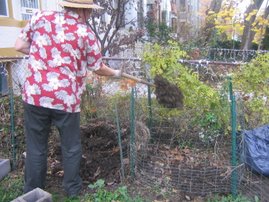
The cucumber plants, meanwhile, were carried to the compost heap and chopped into smaller pieces. Their destiny now is to feed next year's crops. They have our thanks.